Downton Abbey, Season Six, Episode Four

Last week, we had a visit from P.G. Wodehouse.  This week, we receive Edmund Burke.  Molesley quotes the always quotable Burke, as he advises, or more accurately badgers, dear Miss Baxter: “All that is necessary for the triumph of evil is that good men do nothing.”[1]  Miss Baxter is understandably reluctant to agree to go into court and admit publicly that she surrendered her good sense and her moral judgment to a procurer of crime who wore a pleasing face.  Molesley’s study of English history has not led him to an appreciation of the uses of prudence and he jumps to the conclusion that there is only one proper course for Miss Baxter.  It appears that she is going to come around eventually, but not because of Mr. Molesley’s moral certitudes.

Mr. Burke’s second appearance in the tale is not invoked by quotation.  Rather, Burke enters the story through his notion of civil society, that liberty is best preserved through the “little platoons”, the institutions that buffer the relationship between the individual and the state.  Possibly the last person we would expect to champion this notion is Lady Grantham, but there she is in the Crawley drawing room, invoking Magna Carta and sounding for all the world like the intellectual heiress of Edmund Burke as she rails against the intrusion of the national government into domains where local needs might be better served by local institutions, by a smaller platoon than the one to be sent from York, or, eventually, Westminster.

At this point she is grasping at straws, searching in vain for an ally in her battle to prevent the intrusion of the Royal Yorkshire Hospital.  Her first plan was to assemble a shield wall of local notables, including Dr. Clarkson and Lady Shackleton.  Clarkson has abandoned her in the face of Isobel’s piercing moral glare.  Lady Shackleton knows better than to take a firm stand on a subject where her knowledge is limited.  Left to fight alone, Violet enlists a political philosophy that she would not bear comfortably in normal circumstances.  Not that she is against little platoons in principle, as long as it is her platoon that controls things.  Her back to the wall, she invokes the Great Charter.  No doubt, her ancestors were present at Runnymede in 1215, so this is personal for her.  Still, I don’t like her chances.

A couple of episodes ago, when everyone was dancing to gramophone music to celebrate the final end to all suspicion against Anna in the case of Mr. Green, Mrs. Patmore was dancing with Sergeant Willis and it seemed possible that a relationship might develop.  It seems that Mrs. Patmore agrees.  When the good sergeant comes by to talk to Miss Baxter, Mrs. Patmore is hurt that she is sent away before Mr. Willis states his business.  Later, she complains that she, unlike the newly married Mrs. Carson, has not yet been introduced to the “mystery of life”.  The aim of this season seems to be to pair up anyone who is not completely ineligible (not thinking of Mr. Barrow, not at all), so perhaps Mrs. Patmore and Sergeant Willis are going to hit it off.

A couple of weeks ago, I happened to mention Gwen, the house maid who learned to type and became a secretary, as an example of rising female characters.  I did not expect that we would see her again, but here she is, accompanying her fine upstanding husband, the treasurer of Hillcroft College, a man with the fine upstanding name of John Harding.  Before watching this episode, I had hit the “info” button on my Comcast remote, so I knew that a former female member of the staff was going to re-enter the story.  I confess that I did not think of Gwen.  I had hoped that this person would turn out to be Edna, of whom I like many superficial males in the audience have a fond memory.  However, it was a pleasure to see Gwen and to remember the enormous help that Sibyl gave her and to learn that she has used the skills she gained to her advantage and to that of her husband.

The reactions of Barrow and of Mary to Gwen both seem typical.  Barrow can’t stand the idea that this former house maid is now sitting as a guest in the dining room and that he is serving her lunch.  He goes out of his way to, as Robert put it, “catch her out.”  She handles the situation with grace and courtesy, but that doesn’t stop Mary’s inner snob from emerging.  From Mary’s standpoint, Gwen ought to have voluntarily laid her life story before the luncheon company so that her betters could appropriately measure their reaction to her.  They had been treating her as a quasi-equal: the wife of the treasurer of the college on whose board Rosamunde sits.  Mary will require some reflection before she can decide whether quasi-equality is the right fit for this situation.

Gwen gets the last laugh, though.  After lunch, Robert lets Barrow know that his behavior is below the standard expected of a Crawley family servant.  Meanwhile, after Gwen invokes the memory of Sibyl, Mary starts to question the direction and meaning of her own life.  She is actually pleasant to Edith, so Gwen’s magic is starting to work.

I have been waiting for the bird-shooting fellow from last season to show up, the one that Mary teased and insulted while he was trying to reduce the grouse population of Scotland.  When we learned that Lady Shackleton was visiting Downton along with her nephew, I (along with three quarters of the audience) was pretty confident he would turn out to be the same fellow and indeed he was.  He and Mary seem to share similar elegant tastes and light-hearted badinage in the style of Oscar Wilde[2].  They have each found their calling in life.  He will race fast cars, while she will manage the estate for the benefit of her son.  I think we have the start of a perfect relationship.

I was glad to see that we got Mr. Mason settled without having to send over to France for a guillotine.  We knew he was going to move into the Drews’ old place, but the story couldn’t run perfectly straight.  Fortunately, Cora’s feelings were not injured by Daisy’s planned insult, and Daisy’s employment was not disturbed by Cora’s likely reaction.  As someone said, all’s well that ends well.

Anna is with child, and has had the wee stitch that will allow her to carry Baby Bates to term, so that little sub-plot is working out.  We had to strain the British transportation system to its limits, but, again, all’s well.

I don’t know how many more episodes were made for this last season, but it appears that we are going to start pairing couples off in wholesale lots.  Mary and Henry for sure.  Edith and her agent/editor, undoubtedly.  Meanwhile, below stairs we have the potential for Andy and Daisy (that look from him was unmistakable), Mrs. Patmore and Sergeant Willis (just a hunch), possibly even Mr. Molesley and Miss Baxter.  I’m going to stick my neck out and predict that if Andy and Daisy get together, Mr. Mason will give away the bride, after dispensing a suitable amount of country wisdom, of course.  Would Mr. Fellowes’s generosity extend to allowing Mr. Molesley to find work as a teacher and Mr. Barrow to find a satisfactory place as a butler?  We shall see.

The one possible dark cloud is that Robert is experiencing a lot of abdominal pain.  One hopes that this is nothing more than decades of a rich upper class diet catching up to him.  I would hate to think that it could be anything more serious.  I would like to think that when we say goodbye to Downton in a few weeks, Robert will still be there.  He might be clutching his abdomen, but may he still be master of the house.

[1] The quote is attributed to Burke, and its elegance is worthy of his style, but he did not write it and he may not have spoken it.  Please see quoteinvestigator.com for more details.

[2]Perhaps the style of a first draft.

Downton Abbey, Season Six, Episode Three

It seems that the various story lines are separating, each one going its own narrow way.  Could the rich tapestry of interwoven strands of plot be unraveling?

Mrs. Carson – Mrs. Hughes as was – got the wedding service she wanted where she wanted it, and she got a long way toward having the reception she wanted, too.  Mr. Carson was able to fit in a lovely speech, hitting just the right tone, and we were on the verge of tucking into an old-fashioned, although unfashionable, wedding breakfast, when who should show up but Tom Branson and little Sybbie.  It was thoughtless to turn up at that precise moment.  Had they appeared prior to the wedding service, no one could have complained.  After the reception would have been even better.  Right in the middle of the celebration seemed the wrong time for a reunion.

But then, Mr. and Mrs. Carson have to recognize that the light that shines upon them is reflected by the Crawley family, wherever that reflected light happens to fall, whether at Downton or at the local school makes no difference.  If the event had been held at Downton, would the Carsons have been expected to see to it that Mr. and Miss Branson were properly settled before seeing to their own wedding breakfasts?  Mr. Carson, at least, would have been pulled in that direction even if no one else suggested it.  Mrs. Carson’s wisdom in insisting on a service and reception ex Downton is confirmed.

By following Thomas Barrow on his hunt for new employment, we are getting a close-up view of the state of the Yorkshire market for stately homes in 1925.  Prior to the beginning of Thomas’s search, we saw a house that had been sold under duress.  Last week we saw a down-at-heels house where Mr. Barrow would have been asked to serve as footman, chauffeur, and valet.  This week, we visit a once great establishment now on the edge of ruin, its owner on the edge of insanity.  How many more such houses are in the neighborhood?

Where does this leave someone like Mr. Barrow?  He is clever enough to have maneuvered himself to a respectable position as a senior domestic servant in a stately home.  He might have achieved equal or greater success had he taken a different path in life.  He has demonstrated high-order social skills, even if they are often in the service of bad motives.  During the war, he used guile and an ability to ingratiate himself to move from the death sentence of the Western Front’s trenches to hospital service in Yorkshire.  Last season, it required a deep understanding of social relationships for him to devise and implement a plot that resulted in the arrival of Lord Sinderbey’s lady friend, child in hand, at the doorstep of Lord S.’s Yorkshire home.

Had he worked as a politician, an investment manager, a barrister, what might he not have achieved?  The English class system denied him those careers and he took what he judged to be the best available option in the “fat years of plenty” that preceded the First World War.  Now things have gotten leaner.  Several proprietors of great houses in the story have complained that wages had gone up so fast since the war that they can no longer afford to keep the required number of staff.

Why did this happen?  Part of the reason had to be the result of the World War.  About 750,000 British soldiers and sailors died in the war.  That figure does not include the Commonwealth or Empire.  Another two million were permanently disabled.  The British population at the start of the war was roughly 45 million.  If half of those were men, and the great majority of casualties were also men, the male workforce was reduced by perhaps 20% after we account for those too young and too old to work.  I have not tried to research this, but I would reckon that the last time anything like this happened in Britain was the time of the Black Death in the fourteenth century.  A reduction in the number of available workers naturally increases the value of the labor of those who are left.

Add to that dynamic the continued industrialization of the economy.  Mechanization renders labor more productive and therefore more valuable.  Throw in a good measure of the inflation that was used to finance the war, and the price of an hour of labor whether employed in a factory or in setting out a tea service at Downton Abbey was bound to go up.  The income available to landed families was less likely to rise than were their costs.

But where does that leave someone like Thomas?  Tea services, wine cellars, silver platters and all the rest are what he knows.  They are the tools of his trade, but the market that could afford to be served in that way was shrinking in 1925 and would be under severe stress within the span of his working life.  It must have been a horrible situation for people who, it turned out, had painted themselves into a corner without realizing they were doing it.  Eventually, film stars, industrialists, and American millionaires would take over some of the great houses, but I wonder if they maintained staff at the levels that a family like the Crawleys would have required in the years of our story.

It’s nice to see that some of the Downton characters are on the road to happiness.  Edith and the “Agent” – didn’t catch his name – happened to meet as she was heading to the office.  Was it a meeting by chance, or was he waiting for her, having tracked down her address ahead of time?  I was sure they were going to hit it off when he smiled at her last season.  I remember thinking at the time that it would help him to woo Edith if he had a useful skill.  He would need to be able to get beyond shooting birds or sharking cards.

It turns out that he has the most useful skill a publisher could ask for when she has just sacked her editor.  He can help put together a late edition of a magazine.  When Edith, the Agent, and her assistant finished, I thought of the last scene in Casablanca – the start of a beautiful friendship, minus the Marseillaise and the bottle of Vichy water.

Mary did not like it at all when Robert praised Edith for her work in the publishing business.  Mary does not like people who work for a living.  She turned up her nose at Matthew when he was a working solicitor, although she put her snobbery aside in his case, eventually.  Nor is she happy to see Edith being praised for anything.  Put the two together and I won’t be surprised to see Mary do something unpleasant in the closing episodes.  However, if the wealthy bird-shooting fellow comes by, Mary may shelve her plans for Edith.  I think Edith has been through enough and it would be nice to see her story reach its close without further incident.

I confess that my attention has wandered some during the three episodes of Season Six that we have seen so far.  There were two details during the meeting between Edith and the Agent that have nothing to do with the story, but which drew my attention.  One is that in the distance, there was an “Underground” sign.  I understand that Holborn is the Tube station that serves Bloomsbury, but which Underground station are we seeing in the distance, and is the sign authentic to the period?  Also, the white building behind Edith and the Agent had the legend “T N.G.C. 1818” (with the T, minus the full stop, appearing above the other three letters) embossed on either side of the archway that is lined up with the Underground sign in the distance.  At the top of the arch, a smaller emblem shows T CTS 1848.  Again, the T appears above the other three letters.  I wonder what they stood for.  If anyone reading this happens to know, I would be grateful for the information.

I hope we will be able to add Mr. and Mrs. Bates and the good Mr. Mason to our list of characters whose fortunes might be looking up.  Anna appears to be pregnant and she is a train ride away from the London doctor who can keep her that way.  (That didn’t come out right.)  Mr. Mason would be the perfect tenant for the recently vacated Drew farm.  He can tend to the pigs and he can take up the slack in dispensing folk wisdom that will result from Mr. Drew’s relocation.  However, for some reason, Cora is reluctant to announce that this is her plan.  Possibly, Daisy has allowed her hopes and those of Mr. Mason to rise too high.

Cora has demonstrated that she can be rough with the servants when her normally placid emotional state is disturbed.  She almost put a cloud over the Hughes-Carson wedding when she struck out at the Hughes-Patmore-Bates triumvirate.  In her defense, she was entering her own room to relax after an unbelievably brutal day of travel and meetings – the strain would have been something the servants can hardly appreciate – and she did not expect to see three senior members of her staff going through her clothes.  And we can now put aside any thought that Mary was beginning to think of other people’s feelings in her daily dealings.  She could so easily have warned Cora about the distribution of Cora’s clothing that Mary had authorized.  But that would have required her to get out of her chair right in the middle of tea.

Naturally, Cora’s better nature emerges eventually and she goes the extra step of descending below stairs to offer a sincere apology to Hughes and Patmore.  (I don’t think Anna was in that scene.)  So, everything was all right finally, but how unfortunate that the three loyal servants had to be put through such distress on the day before the wedding.

We are learning that Mr. Spratt and Miss Denker each has hidden depths of guile.  Sergeant Willis pays a call to the back door of Violet’s house to question Mr. Spratt about his missing good-for-nothing nephew.  I would have thought that even in 1925 the “Constable’s Guide to Effective Interrogation” would have directed Sergeant Willis to question Spratt and Denker separately.  However, it saves the Sergeant’s valuable time if he questions them both together.  Besides, if he questions them separately, one of them will have to get out of his or her chair and go to a different room, something that everyone in Yorkshire, whether born high or low, seems reluctant to do.

The result is that Denker now knows Mr. Spratt’s tale and has something to hold over him.  Spratt, meanwhile, has kept the P.G. Wodehouse connection warm by hiding someone in the potting shed.  Where this will all lead is a question.  Mr. Spratt is hardly a master criminal, and if Denker stoops to blackmail, her objective will be some minor household privilege and not the thousand pounds that Miss Bevan sought from Mary in Episode 1.  I don’t think there is enough time left in this season for this particular story line to develop or to have much impact.  Let’s hope that Mr. Spratt’s nephew doesn’t commit some foul crime in the meantime.

Am I the only viewer who has had it with Isobel’s hectoring tone and moral certainty?  Among the admirable qualities of the English we must include reserve, tact, and the liberal use of irony and understatement.  Isobel seems to lack each and every one of these.  To her credit, she also lacks some of the vices of the English of that day, including class snobbery and mindless adherence to tradition.  Her attack on Dr. Clarkson struck me as un-English.  She attacked him directly and openly, in a scolding temper, on a question of his personal character, and she did so in a public setting.  It was, or ought to have been, humiliating to him and embarrassing to the rest of the company.  She does eventually apologize, but an insult made in public is never quite erased by an apology given in private.

It’s annoying that her ill manners worked to her advantage this time.  For one thing, Dr. Clarkson is a man of integrity and eventually realized that Isobel’s criticism of him was fair, although put to him in a manner that would have stiffened the back of a less reasonable man.  For another, Isobel is on the right side of the hospital question.  These hectoring people who adopt attitudes of moral superiority are occasionally right, like an out-of-date calendar, and the rest of us just have to put up with it.

One other story thread that may be pointing to a happy outcome is the tale of Mr. Molesley’s missed educational opportunities.  The master at the local school is impressed with Mr. Molesley’s efforts to lead Daisy into the groves of Academe.  Molesley is a man who can distinguish at a glance between the War of the Austrian, and that of the Spanish, Succession.  He might lack the proper credentials, but perhaps a way can be found to move him from footman to his proper role in life.

Finally, to come back to the Hughes-Carson wedding for a moment, I was glad to hear the sound of bagpipes as the service ended.  A bagpipe in the hands of a skilled piper can combine celebration, ceremony, and solemnity as can no other instrument.

I wonder if the short road ahead will run as straight as seems possible at the moment.  We shall see.

Steak Sous Vide, Take Two

I decided to try steak sous vide using a slightly different technique.

First, I made an equipment change.  I retained my Anova Sous Vide circulator, of course.  However, my first adventures into sous vide were undertaken with a metal stock pot.  The metal pot has three disadvantages: (1) the metal radiates heat; (2) there is no lid to help seal in the heat; (3) it’s hard to monitor the progress of the food.

All of these difficulties are removed when you substitute a heavy duty plastic vessel specifically designed for the purpose.  The heavy plastic lid has cutouts to accommodate the sous vide circulator.  In addition, I purchased a metal rack that sits on the bottom of the vessel and holds the bagged food in place.  These photos will illustrate.

IMG_20160119_181020365_HDR

IMG_20160119_181000727

Second, I increased the temperature slightly.  My first steak sous vide was cooked at 129 degrees F.  I thought it was a bit too rare, so I moved this one up to 132 degrees F.  The first one was cooked for 40 minutes.  I found a website that recommended 90 minutes for a 1-1/2 inch thick steak, which is what mine was.

Another change is that I used a prime sirloin steak rather than a prime tenderloin, but only because that’s what I had on hand.

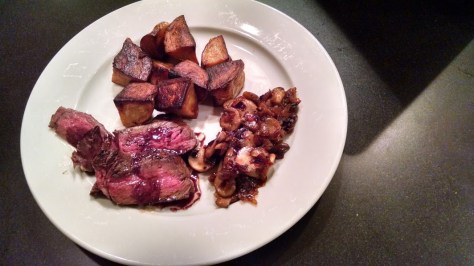
The first time, I finished the steak on the grill, 90 seconds per side.  This second one was cooked on January 19, when there is rain falling in Seattle, a rain so strong that some Seahawks fans are outside looking to the sky to help wash away our tears.  I chose the better part of valor and browned the cooked steak in butter on medium heat for about two minutes per side.  With hindsight, I think 90 seconds per side would have been plenty.

I added my obligatory browned potatoes plus sauteed  onions and mushrooms.  I thought about adding a kale medley (joke) but decided at the end to try a red wine reduction recommended by one of the sous vide websites I found.

Here is what the result looked like.

IMG_20160119_194814441_HDRIMG_20160119_194928024_HDR (1)IMG_20160119_195135141_HDR

And thanks once again to my kids for such a great gift.

Szechuan Chicken Sous Vide

For years, I have been preparing a dish I call “Szechuan Chicken”.  I adapted it from a recipe in a “Zone” cookbook.  It’s very simple.  Boneless, skinless chicken breasts are cut into bit-sized pieces and dredged in corn starch.  They are sautéed.  When they begin to brown, a couple of cloves of crushed garlic are added.  When the chicken is cooked through, several handfuls of green onions, cut into half inch pieces are added.  When those are starting to wilt, I add a sauce made up of about one half cup of soy sauce, one third cup of white wine vinegar, a Tbsp. of sesame oil, 2 tsp. of sugar, and 1-1/2 tsp. of cayenne pepper.  All of those ingredients can be adjusted to taste.  The sauce thickens as you stir and when it is fully thickened the dish can be served with steamed rice.  You can add crushed red pepper to taste.  The dish has nice heat that I really enjoy.  Also, it can be adapted readily for beef.  I use sirloin steak, cut into bite size pieces.

I thought it would be interesting to cook the chicken sous vide, then cut it up into serving pieces, dredge it in corn starch and proceed as above.  One downside to this method is that it takes an hour to cook skinless boneless chicken breasts sous vide, while it takes less than ten minutes to cook the dredged chicken pieces in a sauté pan.  But why not try it?

Before going on, I should acknowledge that there has been a lot of controversy recently, particularly on college campuses, regarding the preparation of foods associated with particular ethnicities.  It is considered a micro-aggression to offer an ethnic dish when (a) the dish is prepared by someone not a member of the same ethnicity as the food and (b) the recipe has been changed in any way from what a born member of that ethnic group would expect.

It’s surprising that college and university food services cannot produce genuine ethnic foods.  When I was a college student and was in the mood for authentic food, the first place I looked was the campus dining hall.  It’s tragic that standards have deteriorated to the point that you can’t count on university kitchens to produce authentic ethnic cuisine.

I would add that in this case, the kitchens of France are churning out micro-aggressions at a pace much more rapid than those of the United States.  French sauces in particular are often named for the geographical area or nationality that inspired them.  French cooks are notorious for taking the basic elements of another nation’s food and sublimating them to French methods.  Cases in point: Sauce Africaine, Sauce Italienne, Sauce Hollandaise, Sauce Allemande.  I could go on.  These sauces no longer have any real connection to the places for which they are named, although the place probably inspired the first effort that has been refined over decades if not centuries.  My point is that the people who are complaining about this particular species of micro-aggression should address themselves to the cooks of France before they complain about anyone else.  Not that they’re listening.

I am not from Szechuan, nor are any of my ancestors that I can account for, so I am in trouble already.  Actually, this recipe involves micro-aggressions within micro-aggressions.  I see that the soy sauce I use is Kikkoman, not a Szechuanese brand.  To make it worse, Kikkoman is produced in Wisconsin.  Where this will end, I don’t know.

A word about cooking times.  This is the third food I have prepared sous vide.  I cooked a steak to 129 degrees, which was supposed to be medium rare.  I thought it was rare.  Delicious, but rare.  I cooked salmon to 122 degrees, which was supposed to be medium.  I thought it was undercooked.  The recommendation for “juicy” chicken breast was 149 degrees for an hour.  I went to 155 degrees, fearing undercooked chicken.  It was not overcooked at that temperature, but I think it would have been better, possibly moister, at 149, which is the temperature I will use next time.

Here is what the chicken looked like straight out of the sous vide.  The second shot shows the interior of the chicken.  The food cooks beautifully but it looks plain and bland.

IMG_20160111_194623326

IMG_20160111_194809697_HDR

This is the chicken in the pan, after dredging with corn starch.  Garlic and green onions have been added.

IMG_20160111_195652810_HDR

Now the sauce goes in and thickens under heat.

IMG_20160111_195904270

Here is the finished dish.  Broccoli could accompany this if you feel that you must have a vegetable.


IMG_20160111_200128415

Downton Abbey, Season Six, Episode Two

Perhaps you will agree that this was not the most tensely dramatic episode of Downton that we have seen.  If so, indulge me in a little digression into the world of P.G. Wodehouse, which intersected the world of Downton in this episode, and not for the first time.

This is the second occasion on which P.G. Wodehouse has paid a call on Downton Abbey.  The first time was back in the early days, Season One or Two.  Mr. Barrow was merely Thomas back then, a footman trying to climb to the next rung of the ladder.  Lord Grantham was known to be extraordinarily fond of Isis the dog.  Thomas had the idea that he could win Lord Grantham’s favor by hiding Isis in an abandoned cottage on the Abbey’s grounds and then, after Lord Grantham had reached a state of high anxiety, finding her the next day.  Unfortunately for Thomas, someone else found the dog.  However, that is not the point of recounting the tale.

The stratagem is straight out of what Wodehouse called his “Blandings Castle Saga”.  Wodehouse is best known for his Wooster and Jeeves stories.  Bertie Wooster was a cloth-headed man about town.  Jeeves was his gentleman’s gentleman, a man of refined taste and profound learning.  His agile brain is put to use in every episode to facilitate Bertie’s escape from the impossible situations in which he lands himself.

However, Wodehouse wrote another series, which he referred to as the Blandings Castle Saga.  Blandings is a large establishment in Shropshire in the west of England, out near the Welsh border.  The castle is the ancestral home of Clarence Threepwood, the ninth Earl of Emsworth.  His sole passion in life is winning the annual Shropshire Agricultural Show Fat Pigs contest.  His prize pig, the Empress of Blandings, is a perennial contender.  Unfortunately for Lord Emsworth, his peace is disturbed in novel after novel by the younger members of his family, an assortment of nieces and nephews who insist on falling in love with completely unsuitable members of the opposite sex.

Four of the novels[1], at least, have remarkably similar plots.  In all of them, the unsuitable suitor comes to Blandings in disguise.  Wodehouse said that Blandings has impostors the way other houses have mice.  And in all of these stories, someone, often the star-crossed lovers themselves, steals Empress of Blandings in order to win points with Lord Emsworth when she is found.  There are always a half dozen other twists and turns of the plot, but in the end everything comes out all right.

How easy it is to take those same plot elements and, with just the slightest adjustment, produce a heart-rending melodrama instead of a side-splitting comedy.  The Fat Pigs contest is log-rolled into Season Six, Episode Two by having Mr. Finch visit the Abbey to talk to the “Agent”.  He and Mary go through a few minutes of “Who’s on first?”  “That’s what I said” until we finally come to the point that there is to be a “Fat Livestock” show on short notice and we need all hands, or in this case all trotters, on deck.  In order to enlist Empress of Downton, Mary needs to pay a visit to Mr. Drew, the Abbey’s pig man (not to mention part-time fireman, full-time dispenser of wisdom, and sometime foster parent).  Mary is the only person in Yorkshire apart from Mr. Molesley who doesn’t know that Marigold is Edith’s daughter, so she naturally takes Marigold along with George to visit the farm, unaware that she is putting a lighted match to the dry kindling of Margie Drew’s emotions.

Poor Margie’s heart is nearly broken in two when she sees Marigold at the farm.  When she sees the child again the next day at the Agricultural Show, she puts a Wodehouse-style plan into action.  But instead of stealing a pig to help bring young hearts together, Margie has stolen a child to heal her own broken heart.  The child was never in any danger, but who knows what might happen next time.  Mr. Drew comes to the same conclusion that Robert had arrived at earlier.  The Drew tenancy, which pre-dates the Battle of Waterloo, must come to an end.

P.G. Wodehouse made sure that all of his characters were taken care of.  Everyone enjoys a soft landing and a happy ending.  Mr. Fellowes cannot afford to be quite so gentle with his characters.  After all the fun of the agricultural show and the excitement of finding the missing child, whose location was never a mystery to the audience, Mr. and Mrs. Drew, two minor characters who have served Mr. Fellowes loyally, are crushed, while Robert, Cora, and Edith must recognize that they have not lived up to their own standards.  A most unhappy end to a difficult chapter in the life of the Abbey.

Incidentally, the butler at Blandings is named Beach.  He and Mr. Carson could give each other a run for their money when it comes to maintaining the proprieties in all circumstances.  I thought Mr. Carson might have edged Beach by a nose when, walking arm in arm with his fiancée, having a private conversation about their wedding plans, he addressed her as “Mrs. Hughes”.  Evidently the wanton informality of first names will not be indulged until they have been pronounced husband and wife.

But where will that pronouncement be made?  Mrs. Hughes wants the service out of the Abbey, neither upstairs nor downstairs, but Mr. Carson cannot break the gravitational pull of the Abbey, particularly after Mary’s insistence that the betrothed couple accept the family’s hospitality.  Mrs. Hughes was prepared to concede Mr. Carson the thirty years that begin on the day after the wedding, but as things stand at the moment, she will not win even that one day.

Anna and Bates get in their statutory round of regret, self-recrimination, and adoration.  At this point, no episode is complete without that little dance.  If they can manage to put their emotional pas de deux on hold for long enough to conceive, Mary’s doctor may have a surgical solution that will allow Anna to carry the next little Bates to term.  I hope for their sake that it comes to pass, although I expect that Anna will then spend her days crying that she’s not a good enough mother to the child.

A few aspects of Thomas’s situation piqued my interest.  First of all, why is Mr. Carson suddenly so hostile to Thomas?  Thomas has been an annoyance for years, but Mr. Carson has put up with him.  Thomas has not been openly offensive to anyone this season, at least not yet, but Mr. Carson seems to have it in for him.  Then when Thomas interviews for a job as an assistant butler – which we learn is a long notch down from an under-butler – the fellow who interviews him is almost openly hostile.

The interviewer is, I assume, the butler at the less-than-stately home where Thomas is applying.  His manner of dress and his accent place him a few rungs below Mr. Carson on the servants’ social scale.  I was curious that he had Thomas’s sexual orientation figured so quickly.  He did not appear to be especially tolerant in that regard, but could there be enough gay servants wandering around rural Yorkshire to bring the question to the front of the officious butler’s mind?  Added to that, the job itself seems unappealing, including as it does the role of footman, valet, and part-time chauffer.  I don’t see Thomas choosing to settle in there, even if he is offered the job.

The theme of the advancement of women is in full bloom.  It’s a subject of long standing at the Abbey.  We remember Gwen from the very first season, the lowly housemaid who became a secretary, and she is not the only example.  Here in Season Six, Mary is now fully in charge as Downton’s agent and Edith is slowly but steadily taking her publishing business in hand.

Isobel is doing a masterful job of winning the argument to modernize the medical services available to the district.  It appears that she has encircled Violet and Dr. Clarkson and left them to stew over their upcoming defeat.  Robert cannot oppose his mother and so remains neutral.  Cora is a stout ally and so is Lord Merton.  Of course, Lord Merton would have sided with Isobel if she had proposed that they hop into a couple barrels and roll their way to London.

But the whole business with the hospital was done in such an undramatic fashion.  In the old days, we would have had an outbreak of scarlet fever and Dr. Clarkson would have stood before a window, his sleeves rolled up to his elbows as yet another body was rolled past him toward the mortuary, and confessed that he was overwhelmed and needed help.  In this lackluster season, will he and Violet do nothing more than sulk until Isobel’s victory is complete?  Perhaps the old guard still have a fight left in them.  We shall see.

Meanwhile, Daisy is becoming more deeply radicalized with every episode.  She wants Cora’s help to restore Mr. Mason’s lease, but she also holds Cora responsible for Mr. Mason’s dilemma.  Of course, she doesn’t hold Cora personally responsible, but Daisy sees Cora as part of the system that has taken away Mr. Mason’s farm.  This kind of proto-Marxist ideology must have been on the rise in 1925.  The next year, Britain experienced the famous “General Strike”.  It was unsuccessful, but was a clear sign that the workers were not satisfied with their lot in life.  Whether our story will reach into the next calendar year remains unknown (to me).

I was gratified to see that a few predictions I have offered – always reluctantly after the shocks of 2012 – are on the verge of coming true.  Cora has indicated that she has an idea in mind for Mr. Mason.  I would wager a small sum that she is going to arrange for him to take over the Drews’ farm, from where he will be able to assist Mary in keeping the pigs and advising on the agricultural affairs of the Abbey.  Also, looking at the previews of the coming week’s episode, I see that the fellow who showed an interest in Edith last season – the “agent” at the estate next door to the Sinderbeys – was talking to Edith.  Finally, the fellow who was shooting pheasants while Mary insulted him will also be making an appearance.  I don’t think it took any great insight to make any of these predictions, but having tasted the bitter dregs when I have been wrong, I look for any chance for vindication.

One last point.  This episode and the previous one opened in the usual way with a close-up shot of Isis’s tush.  The dog died last year.  Shouldn’t we have an updated opening?  The end of the show is in sight, so it’s understandable that the producers would hesitate before investing in a new opening segment, but surely budgets are not that tight.  If each of the upper class ladies gave up one extra gown, that would undoubtedly cover the cost and it would help me to avoid asking each time why we are seeing the hindquarters of a dog that died a year ago.

[1] Summer Lightning, Heavy Weather, Pigs Have Wings, and Full Moon.  The first two form a sequel and are comic novels of the very first order.  Possibly there is a barely noticeable recession of quality in the third novel.  The fourth, Full Moon, is a work of comic genius.  There are other Blandings novels and a collection of short stories as well.

Downton Abbey, Season Six, Episode One

In real life, we never know when we are in our last season or when anyone else is.  The Downton writing crew, however, knows that they are facing the end.  It is mere weeks away.  Are we going to end on a note of gloom or one of hope?  The battle is going to be just as fierce as anything that Isobel and Violet have gotten on.  The forces of gloom seem to have a strategic advantage, but hope manages to get in a few good licks.

As Exhibit A on the hope side of the equation, we have Anna and Bates, but their version of hope is so tiring that they actually make gloom look good.  Here is how I expect one of their early morning conversations might go when no particular tragedy is looming on the horizon:

Bates: “Good morning, my darling.”

Anna: “How can it be a good morning when I am so unworthy of you?”

Bates: “You could never be unworthy of me or of anyone.  You are the most perfect angel and my only hope is to provide you with a fraction of the happiness that you have provided me.”

Anna: “You are so kind to pretend that you are happy when I know how disappointed you must be.”

Bates: “My darling, is that smoke coming from the toaster?”

I expect that in later years, the Bateses will find conversation on any topic to be exhausting.  The lightest subject leads the two of them almost immediately into narrow channels of self-recrimination, adoration, and devotion.  It will soon become impossible for either of them to get anything done if the other speaks.  I don’t think the Hallmark card people were selling in England in 1925, but when they get there, I picture the Bateses filling their back room – the room that, alas, might once have served as a nursery – with cartons of Hallmark cards.  If either of them starts a conversation on any topic, the other one hands over a card and that’s an end to it.

The ray of hope that finds its way through the gloom surrounding Mr. and Mrs. Bates is generated by the good news that the case against Anna may finally be closed, pending collection of perhaps just one more piece of evidence.  I thought the whole case had been dropped at the end of last year, but it was not so.  The case against Anna remains alive even after a different victim of Mr. Green has confessed to killing him.  The legal system that sent Bates to prison for a crime he didn’t commit and that has held Anna in the grip of its suspicion for some three story years, suddenly turns skeptical when the true killer shows up and confesses.  “Sorry, Miss.  We need more than your word.  We’d have to double the size of our prisons if we started convicting murderers based on nothing more than a confession.”

Not to worry.  An eyewitness appears and supplies the police with the missing piece of the puzzle.  She did not witness the crime, but she saw Mr. Green and his self-confessed killer together in a pub.  That’s good enough for the police this week.  And it’s a good enough excuse to break out the gramophone and the Veuve Clicquot – not properly chilled, but cold enough for an impromptu celebration with the staff – to chase the blues away from Downton Abbey, if only for one evening.[1]

But the gloom keeps pressing in.  The Abbey’s finances are beginning to pinch.  Many great houses must have faced the same dilemma.  They needed lots of staff to run a place that large, but the wage necessary to attract the required number had grown beyond the owner’s means, unless, like Lord Sinderby or the newly rich Mr. Henderson down the road, the owner had an income apart from the estate itself.  (How wages went up must remain a mystery.  Britain had no minimum wage law at the time.  Could wages rise on their own, without intervention from the state?  That’s a puzzle.)

So far, Robert has managed staff reductions through attrition, not replacing a footman here or an under-house-parlor maid there when they move on to other work.  Carson points out that this can’t go on.  He is practically down to his last hall boy.  On the other hand, the estate sale down the road points out too clearly what lies ahead for a landed family that doesn’t husband its resources.

The Crawleys could move to a more modest house and still live better than all but a handful of landed families, but it would mean a downgrade to their social standing.  And it would mean a downgrade to their self-respect because they would have to lay off so many honest hardworking people who had come to rely on them, and who would now have to find their own way.

The way the board divided over the future of the hospital was telling.  Violet and Dr. Clarkson oppose joining the Royal Yorkshire Hospital for purely parochial reasons — it would diminish their positions.  Violet likes ruling her local roost and Clarkson does not like professional interference.  Lord Merton likes to be on the same side as Isobel, so he sides with her after making sure that he understands what her position is.  Isobel is not to be bought off so easily.  She wants loyal, heartfelt support or none at all.  So far, her only ally is Cora.  This will be a bitter fight.  Isobel sees a clear opportunity to improve the work of an important local charitable organization.  Violet intends to defend her turf.  Neither of them will be easily deterred from her goal.

Several other characters showed steel resolution.  The least successful of these was Daisy, who may have learned her lessons in social engineering from Miss Bunting only too well.  We recall that the Bunting method is to express outrage and then develop a plan.  Daisy streamlines this process even further by eliminating the second step.  We can imagine an English landlord, newly installed in his Yorkshire residence, who likes a tenant family with a bit of spunk and immediately reinstalls dear Mr. Mason at a reduced rent as soon as Daisy has finished her oration.  Unfortunately, Mr. Henderson is not a landlord of this type.  Instead, he states in the clearest terms that if he should happen to decide to let a tenant or two back onto the estate, Mr. Mason will not be among them.  So, gloom appears to be winning the day in the Mason family.  However, I see a potential ray of hope.  Perhaps Mr. Mason will move to Downton Abbey and assist Mary in managing the agricultural end of the business.

Mary is getting the job of business agent for the Abbey because she demonstrated resolution of her own, facing blackmail in her case rather than eviction.  It’s interesting how a Yorkshire accent can emphasize a person’s basic character.  A kind soul such as Mrs. Patmore sounds even more kind and down to earth when she turns every second vowel into a double o.  Daisy’s passion for justice burns even hotter and Ms. Bevan’s contempt for her betters becomes even more toxic when expressed through the long, broad vowels of a Yorkshire tongue.[2]

Ms. Bevan is one of those nasty pieces of work that wander through this story from time to time.  The thousand pounds she wants for her silence would have been a spectacular sum at the time.  I found a source that indicates that in 1925 a fireman earned 15 pounds a month, while a bricklayer might earn 8 pounds a week.  A thousand pounds would have been several years pay for either of them.  Hats off to Mary for telling Bevan to go do her worst and take a hike.

The strength of her resolve does not have to be tested because Robert turns out to be even steelier, and a master negotiator to boot.  He gets Bevan down to a mere fifty pounds and to get even that she has to sign a statement confessing to blackmail, which will ensure that she goes to jail if she ever breathes a word of the scandal on which she was trading.  Mary is in the clear, and her father has come to see her as a force (what with riding astride her horse, arranging pre-marital assignations in York hotels, and staring down would-be blackmailers) who can take on the management of the estate and, if need be, a lot more.

I thought that Edith found herself in the most interesting situation of all the Crawleys.  When you consider that she was never actually engaged to Michael Gregson – he couldn’t undertake to marry her while he had a wife still living – and that Michael could not have known that Edith was carrying their child, she seems to have done quite well out of the relationship.  He left her his publishing business and his Bloomsbury apartment.  I’ve raised the point before, but you have to wonder what Mrs. Gregson was left with.  She is a patient in a mental hospital and is going to require skilled care for the rest of her life.  Yet none of her legal representatives seems to mind at all that Mr. Gregson has left a string of valuable assets to a woman who – how does one put this delicately? – solemnized her relationship with him through one overnight visit to his flat.  It’s another of these little curiosities in the plotting that don’t make a lot of sense.

Apart from that, Edith has some terrific alternatives to choose from.  She can pursue a career in editing, publishing, and writing in London, using her fabulous Bloomsbury flat as a base of operations.  She can install Marigold there, or she can leave Marigold to mature into a country lass in Yorkshire, visiting on the weekends and on holidays.  Or, she can pursue the life she was born into as a member of the Yorkshire gentry.  If she chooses not to run the publishing business, she will still have the income from it and if she chooses not to live in the flat, she can have the income from that.  She appears to have some family money to boot, so her finances will be secure for years to come.  We all know that the Great Depression is looming up ahead, and may ruin the entire family, but at the rate we are going the story will be long over before that arrives.  We needn’t worry about it now.  I look forward to learning which path Edith chooses.

There was a fair amount of big-time name dropping in this episode.  Edith tells Rosamunde that she met Virginia Woolf and Lytton Strachey in the flat, when it was Michael’s.  Rosamunde had just commented that she expected to see members of the “Bloomsbury Set” sitting in the corner.  Woolf and Strachey were both in it.

The final name to be dropped was that of Oliver Cromwell, who had told his portraitist that he wanted to be shown “warts and all”.  That’s how Mrs. Hughes offers herself to Mr. Carson, who gladly accepts, good fellow that he is, after the most awkward sequence of oblique sexual references this show has produced since Thomas Barrow’s experiments with a hypodermic needle last season.  Is English richer in euphemisms than other languages?  When a cook, and a housekeeper, and a butler discuss the groom’s amorous intentions in Spain, or Germany, or Russia – I refuse to believe that the subject would even be thought of in France or Italy – can their language bear the strain of so much indirection?  Let us wish Mr. Carson and Mrs. Hughes all happiness, and for my money, if they care to shield their private affairs from the eyes and ears of the audience from this point forward, I for one will not object.

A final note about the “hunting” scene.  I count this the second such scene in the series.  The first one came in one of the early seasons, Season One or Two I think, and contained a bit of self-referential humor that Mr. Fellowes seems to enjoy.  The 19th century novelist Anthony Trollope was an avid fox hunter and included an extended hunting scene in one of his “Palliser” novels.  (There may be lots of others in other Trollope novels.  I don’t know.)  When Downton had its first hunting scene years ago, one of the characters said that he felt like he had just walked into a Trollope novel (or something along those lines).  Now it’s 1925 and we have another hunting scene.  However, this time the hunting party is much reduced.  There couldn’t have been more than ten riders, while I recall a near mob of horses in the earlier scene.  Perhaps this is further evidence of the slow decline in the fortunes of the Crawley family.[3]

I look forward to the continuation of this last season.


[1] Robert’s toast to British justice is another example of his abundant self-satisfaction, although as I think about it, if you were accused in 1925 of a crime you didn’t commit, your chances of acquittal were probably better in Britain than almost anywhere else.

[2] A friend who grew up in Sheffield told me that a Yorkshireman is very much like a Scotsman, but lacks the Scots sense of generosity.

[3] When Ernest Hemingway was asked how he went broke, he is supposed to have said, “Slowly at first.  Then all at once.”