For years, I have been preparing a dish I call “Szechuan Chicken”. I adapted it from a recipe in a “Zone” cookbook. It’s very simple. Boneless, skinless chicken breasts are cut into bit-sized pieces and dredged in corn starch. They are sautéed. When they begin to brown, a couple of cloves of crushed garlic are added. When the chicken is cooked through, several handfuls of green onions, cut into half inch pieces are added. When those are starting to wilt, I add a sauce made up of about one half cup of soy sauce, one third cup of white wine vinegar, a Tbsp. of sesame oil, 2 tsp. of sugar, and 1-1/2 tsp. of cayenne pepper. All of those ingredients can be adjusted to taste. The sauce thickens as you stir and when it is fully thickened the dish can be served with steamed rice. You can add crushed red pepper to taste. The dish has nice heat that I really enjoy. Also, it can be adapted readily for beef. I use sirloin steak, cut into bite size pieces.
I thought it would be interesting to cook the chicken sous vide, then cut it up into serving pieces, dredge it in corn starch and proceed as above. One downside to this method is that it takes an hour to cook skinless boneless chicken breasts sous vide, while it takes less than ten minutes to cook the dredged chicken pieces in a sauté pan. But why not try it?
Before going on, I should acknowledge that there has been a lot of controversy recently, particularly on college campuses, regarding the preparation of foods associated with particular ethnicities. It is considered a micro-aggression to offer an ethnic dish when (a) the dish is prepared by someone not a member of the same ethnicity as the food and (b) the recipe has been changed in any way from what a born member of that ethnic group would expect.
It’s surprising that college and university food services cannot produce genuine ethnic foods. When I was a college student and was in the mood for authentic food, the first place I looked was the campus dining hall. It’s tragic that standards have deteriorated to the point that you can’t count on university kitchens to produce authentic ethnic cuisine.
I would add that in this case, the kitchens of France are churning out micro-aggressions at a pace much more rapid than those of the United States. French sauces in particular are often named for the geographical area or nationality that inspired them. French cooks are notorious for taking the basic elements of another nation’s food and sublimating them to French methods. Cases in point: Sauce Africaine, Sauce Italienne, Sauce Hollandaise, Sauce Allemande. I could go on. These sauces no longer have any real connection to the places for which they are named, although the place probably inspired the first effort that has been refined over decades if not centuries. My point is that the people who are complaining about this particular species of micro-aggression should address themselves to the cooks of France before they complain about anyone else. Not that they’re listening.
I am not from Szechuan, nor are any of my ancestors that I can account for, so I am in trouble already. Actually, this recipe involves micro-aggressions within micro-aggressions. I see that the soy sauce I use is Kikkoman, not a Szechuanese brand. To make it worse, Kikkoman is produced in Wisconsin. Where this will end, I don’t know.
A word about cooking times. This is the third food I have prepared sous vide. I cooked a steak to 129 degrees, which was supposed to be medium rare. I thought it was rare. Delicious, but rare. I cooked salmon to 122 degrees, which was supposed to be medium. I thought it was undercooked. The recommendation for “juicy” chicken breast was 149 degrees for an hour. I went to 155 degrees, fearing undercooked chicken. It was not overcooked at that temperature, but I think it would have been better, possibly moister, at 149, which is the temperature I will use next time.
Here is what the chicken looked like straight out of the sous vide. The second shot shows the interior of the chicken. The food cooks beautifully but it looks plain and bland.


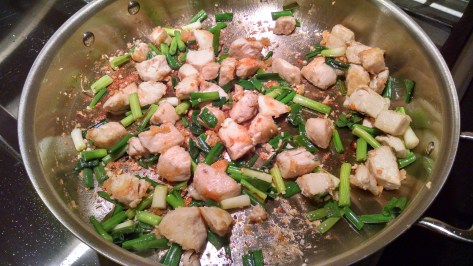
This is the chicken in the pan, after dredging with corn starch. Garlic and green onions have been added.
Now the sauce goes in and thickens under heat.

Here is the finished dish. Broccoli could accompany this if you feel that you must have a vegetable.

 The Passing Scene