Downton Abbey, Season Six, Episode Eight

I’ll begin with an apology.  When I wrote out my thoughts about Episode 7, I thought that Episode 8 was the end of the series.  Had I realized that there was still one more episode to come, I might have drawn different conclusions on one or two subjects.  In my defense, when I looked at “Scheduled Recordings” on my DVR, I saw that Episode 8 was longer than a standard episode — some 80 minutes, including the Viking Cruise commercials – and I also saw that the recording for the following Sunday was a “Making of Downton” program.  That seemed to confirm my understanding that Episode 8 was going to be the end.  I drew the wrong conclusion.  In compensation, this commentary is offered free of charge except for a small fee for handling.

With so many story lines needing to be tied off, it is just as well that we have one more episode.  Looking back with now perfect hindsight, I can see that it was too much to hope for that both Mary and Edith could accept their respective fiancés and celebrate their respective weddings within the span of a single episode.  Mary needed most of Episode 8 to get to the altar.  Fresh from the tearful phone call that concluded Episode 7, she sent off a confirming letter of rejection and then sent off Henry himself when Tom maneuvered him to Downton’s front door.

Henry presents so many issues for Mary that we can take pot luck.  He is not Mary’s financial equal and will be of significantly inferior financial and social status to his stepson.  He will spend his married life living in someone else’s house.  If he and Mary have children, they will be relative paupers compared to their half-brother.  But most important, Henry will walk past the Grim Reaper, nodding his head to a familiar acquaintance, every time he goes to his job, never knowing whether this day is the one when the G.R. decides to ride with him.

It’s that last problem that sends Mary into tears.  Fortunately, Violet reappears after Tom sent for her.  I should have known that she would not abandon the audience before the finale.  She adopts a novel attitude, completely devoid of the financial and dynastic calculations she made when we last saw her discussing Henry with Lady Shackleton a few episodes back.  Now she is the Mr. Mason of the upper classes and counsels Mary to follow her heart and throw caution to the winds (I think two clichés are enough).  And so Mary says Yes.

I would also say that Henry, a fellow who is scraping along with no money to speak of, manages to appear in each scene with perfectly tailored clothing appropriate for each occasion and with elegant and expensive transportation whenever he needs to travel.  He does well for a man without any money.

As busy as Mary was on her emotional shuttle, she still found time to wound those around her.  She was able to blame her father for Barrow’s attempted suicide in the time it took to pour a cup of tea.  And she was able to wreck Edith’s chances for happiness in less time than it took to butter a piece of toast.  Of course, it was idiotic for Edith to think of keeping Marigold’s parentage from Bertie.  One of the reasons the British upper classes gave, probably still give, for their place in society was that they set an example.  It should have been clear as crystal to Edith from the beginning what the right thing was to do.  Not only that, but no one could expect to build a marriage with a deception sitting right at the heart of it.  And there is the practical problem that the truth always does come out eventually.  In this case, the truth’s appearance came early, aided by a heartless and vindictive sibling, but it was only a matter of time.

So Bertie has gone off to Tangiers without Edith.  But this is the benefit of having an entire additional episode, one that I did not budget for, in which to work out the problems that remain after the general roundup of Episode 8.  Does anyone doubt that Bertie and Edith will end up married?  How it will happen we cannot say.  Bertie may come back to Downton, or he and Edith will meet somewhere by chance, or Edith will write, or Tom will intervene, or Violet will be wheeled into action again.  A long-shot possibility is that Mary, experiencing remorse for the first time in her life, will contact Bertie on Edith’s behalf to make one final sisterly plea.   I remain confident that Bertie and Edith will wed however it may be arranged, and I’m sure that 90% of the viewing audience is of the same opinion.

Quite a number of other story lines were resolved in this episode, suggesting that the final episode (or The Final Episode if you prefer) will have enough slack to allow plenty of time for the tale that will bring Edith to the altar to be complicated and slow moving.  At each development, there are numerous characters who will want to talk about it among themselves: Robert, Cora, Rosamund, Violet, Isobel, Mary, Henry, and Tom, not to mention all of the downstairs staff who might spare a thought now and again for Mary’s less glamorous sister.

Two other characters who were settled in Episode 8 are Mr. Barrow and Mr. Molesley.  Barrow was another beneficiary of the additional episode that I failed to anticipate.  If the writers had only eight episodes to deal with, they might have been tempted to close the series with the shocking discovery of Mr. Barrow doing his best imitation of Frank Pentangeli in The Godfather Part II.  But with an episode in hand, there is time for Barrow to recover, to receive a restorative orange from Master George, and to be allowed to keep his job “if only for the time being” as Mr. Carson so cheerfully put it.

Molesley starts his new job as a teacher.  He gets off to a rough start when the students behave badly.  A bit of encouragement from Miss Baxter and from Daisy is all it takes to buck him up and he proves to be a natural, as Daisy says.  If he had been teaching in the same school today, he would probably have bled out from knife wounds on the first day.  Oh, and thanks to Mr. Carson for his words of encouragement to Mr. Molesley.  What a perfect antidote he provides to ambition and a desire for self-improvement.

Mr. Carson was not content to limit himself to discouraging Mr. Molesley.  As an equal opportunity pessimist, he was willing to paint a picture of ruin for Mrs. Patmore to contemplate.  You may recall that my first guess about Mrs. Patmore’s guests was that one of them was a co-responding witness.  That didn’t pan out, but my second guess did.  (The reader is respectfully invited to examine footnote 4 from the comment on Episode 7.)  This is enough to cause Mrs. Patmore’s cottage to become a “house of ill repute.”  Surely that phrase does not have the connotation in British English that it has in the United States.  Mrs. Patmore can hardly be expected to vet the marital status of each guest who books a visit to the cottage.  A “house of ill repute” is one whose purpose is to conduct the activity that gives it that reputation.

Whether the term is fairly applied or not, Mr. Carson helps to increase Mrs. Patmore’s sense of desperation.  He claims, falsely, that he always thought the house was a bad idea.  He announces that he is going to take steps to ensure that his investment is not ruined the way Mrs. Patmore’s has been.  To top things off, when the family agrees to rally to Mrs. Patmore and allow themselves to be photographed leaving her cottage after taking tea there, Carson tries to discourage them.  Like Denker down the road, he is more snobbish than the nobs themselves.  Mrs. Patmore’s immediate problem seems to be on its way to resolution.  The only missing element is her eventual union with Mr. Mason and again we are thankful for the extra episode (as I will continue to think of it) to give us time for that loose end to be knitted up, should Mr. Fellowes be so inclined.

The fate of Isobel and Lord Merton is also in Mr. Fellowes’s hands, acting through his agent Larry Grey (whom I have called Larry Merton in the past because I forget that these upper class people have a family name as well as one or more titled pedigrees).  Isobel seems to have decided that she will accept Lord Merton if Larry gives his blessing.  Presumably she wants to feel that she has his heartfelt assent.  It will not be enough for him merely to speak a form of words.  We shall see whether Larry is up to it.  My hope is that Isobel remains independent, but she hasn’t asked for advice.

I would like to add a note about Chateau Chasse-Spleen.  I agree with Samuel Johnson: “He who aspires to be a serious wine drinker must drink claret”[1].  There are some 10,000 producers of Bordeaux wine, so to sample even a small fraction would be the work of decades (for people who intend to be sober for at least part of their day).  Although I consume more than my share of the wine of Bordeaux, I had never tried or even heard of Chateau Chasse-Spleen.  I was intrigued by the name when it was mentioned a couple of episodes ago.  I decided to try it.  Total Wine had only one vintage, 2009, a very good year in Bordeaux and drinkable now, so I bought a couple of bottles.

The wine has a pleasant dark garnet color, but I thought the tannins were still too pronounced to enjoy the fruit.  I drank the first bottle over three days and I will put the second one away for a couple of years.

I remained curious about the unusual name of the wine.  There are numerous theories.  I mentioned that Lord Byron visited the chateau from which Chasse-Spleen was eventually hived and commented that the wine was a “remedy to chase away the spleen”, spleen meaning “the blues”.  But was he speaking of this particular wine or of wine in general?  Lord Byron was a man who enjoyed his wine and one can find many quotes attributed to him on the subject.  Not all of them were spoken while he was on this property.

Interestingly, the word “spleen” entered the French language via Lord Byron’s use of it.  The word “spleen” naming the digestive organ entered English via the French word “esplen” but “spleen” in the sense of melancholy or the blues entered French from English and specifically from Byron.  The poet Charles Baudelaire used the word “spleen” extensively and an entire section of his foremost work “Les Fleurs du Mal” or “The Flowers of Evil” is titled “Spleen et Idéal”.  Several of the poems in the series have the word Spleen in their title.  But what does this have to do with wine?

We get closer to an answer when we learn that Beaudelaire wrote another series of poems, he called them prose-poems, titled “Le Spleen de Paris” or “Paris Blues”.  This series was published in 1857, the year in which the first edition of Les Fleurs du Mal was published.  One of the poems is titled “Enivrez-vous” or “Get yourself drunk.”  It contains the lines: “Enivrez-vous sans cesse! De vin, de poésie, ou de vertu a votre guise.”  A possible translation: “Be drunk all the time!  From wine, poetry, or virtue, as you choose.[2]

Those lines appear on the front label of each bottle of Chateau Chasse-Spleen.  What French winemaker would not want to name Charles Beaudelaire the national poet of France?

The final connection is that the artist Odilon Redon illustrated an edition of Les Fleurs du Mal, apparently after Beaudelaire’s death in 1867.  Redon came from a town just down the road from Chasse-Spleen.  The suggestion that he proposed the name is plausible.  I feel the connection is complete.  There is no definitive explanation, but one can imagine how the name came to stick through a series of coincidences.  The surprising thing is that there are not more chateaux in Bordeaux using the name “Spleen”.  No one could be melancholy after a couple of glasses of good Bordeaux wine.

I realize that this digression may be of limited interest.  Possibly I can make it up to you by sharing two quotes about wine that I found when I was tracking down the background on Chasse-Spleen.  First, from an otherwise unidentified Spanish bishop: “I have enjoyed great health at a great age because every day since I can remember, I have consumed a bottle of wine except when I have not felt well. Then I have consumed two bottles.”  Second, from W.C. Fields: “I cook with wine; sometimes I even add it to the food.”

Three final thoughts.  First, was it not a lovely thing that three of Mary’s closest relations – her father, sister, and brother-in-law – were able to take a turn unloading on her?  Her father gave her only a single sentence, but one dripping with contempt.  Tom lit into her more extensively and Edith delivered a quarter-century of pent-up resentment with a single word.  Very satisfying for those of us who are not fans of the elegant Lady M.

Second, Bertie’s description of his mother making “Mr. Squeers look like Florence Nightingale” is surely unfair.  The distinguishing feature of Mr. Squeers – the headmaster of a Yorkshire boarding school in Dickens’s “Nicholas Nickleby” — was not that he was strict or maintained high standards.  He was sadistic and dishonest.  Bertie’s mother can’t be that bad!  I’m sure she and Edith will get along beautifully.  No doubt she will be delighted to welcome Marigold as well.

Finally, the name of Bertie’s new home, the place where we had the bird shooting last year, is Brancaster Castle.  P.G. Wodehouse is looking in on Downton once again.  At some point before he was employed by Bertie Wooster, Jeeves was the butler to Lord Brancaster.  I think these little coincidences are worth a smile if not an outright chuckle.

My glass of Chasse-Spleen is drained.  The blues are chased away, and I await the last episode of Downton the Sunday after next.

[1] Claret, to the British, is dry red Bordeaux wine.

[2] The label attributes the lines to Les Fleurs du Mal.  I hesitate to suggest a correction to a French winemaker on a point of French poetry, but I believe the label is incorrect on this small point.

Downton Abbey, Season Six, Episode Seven

The writers have dangled death in front of us in recent episodes.  Robert didn’t have a simple ulcer attack.  Instead, he had to worry us by shooting blood all over the tablecloth and any guests or family members who were within spitting distance (literally).  But he lived.  In Episode Seven, we have an auto race and right before the start, Henry gives Mary a kiss full of meaning and says that he’ll see her at the finish.  You might as well paint “Someone’s Going to Die” in place of all those Dunlop signs.

I thought Henry might be shipped out of the story, but he survived.  Minor characters often bear the brunt of these foreshadowings.  Fans of the old Star Trek TV show will recall that on those occasions when Kirk, Spock, and McCoy beamed down to a new planet and took a fourth person along — usually an ensign that we hadn’t seen before – that character was dead within minutes.  Same thing here.  I’m surprised the fellow lasted as long as he did.

Of course, this completely ruins Mary’s relationship with Henry.  He already had two strikes – lack of a title and lack of funds – but a career that invites death into the marriage every time Henry goes to his job, that’s a little too much, don’t you think?  Only kidding.  Mary clearly is going to end up with someone at the end of the series and it appears that there is only one more episode.  There isn’t time for anyone besides Henry[1].  Besides, he suits Mary.  He has the right tone, style, and manner.  He just lacks ready money.  I predict that she’ll come around.  I don’t say that they will live happily ever after, but I think they’ll make it past the end of Episode Eight.  After that, they are no longer our responsibility.

Edith has at last received a proposal of marriage from a man who is not (a) twice her age or (b) already married.  I think she will have to do more for Marigold than just ask whether the child can come along.  Possibly that is what she needs to think about.  If she turns this fellow down, the next most likely place to look for a beau would be where she works, in Fleet Street, where it will be difficult to find someone who is both temperamentally suitable and of her social class.  Also, Edith is operating under the same time constraints as Mary.  We have only one more episode to get this story line resolved.  I think we have to assume that Edith is going to tell Bertie about Marigold.  He’ll be fine, she’ll say yes, and we’ll have another Crawley settled.

There seemed to be no reason for the writers to bring the editor of Edith’s magazine to the auto race except to have her meet Tom.  He likes feisty, independent women.  She fits the bill, and as a dividend, when dining among the upper classes she does not goad her host into uncontrolled rage.  If that works out, there’s another Crawley settled, although I recognize that I am speculating.

One question I had about the editor was how she managed her change of clothing.  She couldn’t show up at Rosamund’s house for dinner wearing the togs she had on at the race.  Everyone else at dinner was staying at Rosamund’s, or possibly at the Crawley mansion in London, so they had a place to keep their dinner clothes and to change into them.  Did the editor pack a bag and bring it with her to Rosamund’s, or did she go home between entertainments, or what?  In an age when people had to wear exactly the right clothing for each of the varied events in their lives, how did someone who was not a member of the leisure class manage it?

It is good that we have unraveled the mystery of Larry Merton’s sudden change of heart.  Now that we know the truth – and thank you Violet for getting to the truth so quickly and efficiently – it’s obvious that the only person who could have been attracted to Larry Merton would be someone equally unpleasant.  I confess that I was taken in, but I’m glad that Violet was not.  If Isobel does decide to wed Lord Merton, she will do so with her eyes open.  I hope that she will retain her independence.  We shall soon know.

Violet is leaving to cruise the Mediterranean and then to spend “a month among the French”.  Someone pointed out to me that Maggie Smith made a movie in 2015 (The Lady in the Van), so it is possible that Violet left the story when she did to allow the actress to go to work on her new role[2].  We may not see her again.

When Mrs. Patmore and Mrs. Hughes – let’s stay with her professional name – put their heads together, they can solve any problem, even the problem of Mr. Carson.  Three pennies’ worth of bandages was all it took to effect a complete role reversal.  We can expect to see a more reasonable Mr. Carson at our next meeting, now that he appreciates the hard work it takes to organize a meal that will meet his standards.  And Mrs. Hughes was able to induce Mr. Carson to sit on the family’s own sofa!  Next, he’ll be discussing Wat Tyler and Karl Marx with Daisy.

When Mrs. Patmore first purchased her house, I got the idea that it was at some distance from Downton.  I think I remember Mr. Carson traveling with her to see it.  Now it turns out that the house is a short walk away from the Abbey.  She has had her first guests, a nice prosperous-looking middle class couple.  I am going to throw caution to the winds and speculate about the man waiting with a camera out in the lane.  I think the woman at Mrs. Patmore’s cottage may be what was called a professional co-respondent.  In those days, a divorce, even an amicable divorce, would be granted only for cause, and cause meant adultery.  One of the married pair would be supplied by counsel with a professional witness, a member of the opposite sex.  The two would spend a night in a hotel or a BnB and would arrange to have their picture taken for evidence[3].  If my guess is correct, Mrs. Patmore may find that her cottage will be used regularly by one half of an unhappily married couple and a hired witness.  Possibly not the respectable source of retirement income she was looking for, although it would be steady.  Again, I am guessing.  If it turns out I am wrong, I will come back and edit this paragraph out[4].

It’s nice to see that Mr. Molesley will be able to fulfill his destiny and become a teacher at the local school.  His performance on the general knowledge examination may have exceeded the schoolmaster’s expectations, but Mr. M’s fans in the audience knew that he would come through.  We were not surprised.  It’s not clear whether dear Miss Baxter will join Mr. Molesley as he moves ahead.  If the two of them end up together, it will be one more piece in the general pattern of pairing off all available hands above and below stairs.

Mrs. Patmore has brought Daisy around on the subject of Mr. Mason, and Andy and Daisy each know where to find each other, so the only odd man out seems to be Mr. Barrow.  And he seems to be in a very bad way.  He tries to sit with the Carsons to enjoy a quiet moment in the family’s own parlor, but Carson refuses him.  He has obviously made some progress with Andy’s reading, as Andy can sound out quite a few words in a text that is too difficult for a beginning reader.  However, Andy’s trouble has been exposed in front of the kindly schoolmaster (whose name I don’t recall), whose role in life seems to be to improve the members of the Downton staff one by one.  As a result, Mr. Barrow is now pushed out as Andy’s teacher.  To add to his troubles, whenever he sees Mr. Carson, all he hears are questions about when he will be gone.

But as he told us, Downton is the only place where he has put down roots.  We will soon know how this ends for Thomas, but I see two possible paths (assuming that a handsome stranger does not arrive in the village during Episode Eight).  One possibility is that Mr. Molesley’s good fortune will provide Thomas with the opportunity to stay at Downton.  He can accept a demotion to footman, or perhaps “under-butler”, and remain at Downton, hanging on to the place with his fingernails.  The other is that he reacts to the inexorable decline in his fortunes . . . badly.  I would appeal to Mr. Fellowes.  Thomas has served you well through six seasons.  He has not been an angel or even a particularly good person, but he has had a lot to deal with.  I hope for the best, but I think we should be prepared for the possibility of a dark ending.

But let us not predict.  Let us wait for developments, which are only days away.

[1] I suppose Evelyn Napier could be bussed in at the last minute.

[2] According to the movie’s website, her character is a homeless woman who lives in a van.

[3] I am not suggesting that they would have gotten up to anything.  Their time together was strictly for the purpose of providing evidence.  There is a Fred Astaire – Ginger Rogers movie that uses this plot, The Gay Divorcee (1934).  The song “The Continental” is featured in the movie.

[4] Another possibility is that the woman may not be a professional witness at all, and this may be actual adultery, the photographer being employed by the wronged spouse of one of them.  If that turns out to be the story, I may leave the paragraph in.  I hope people read the footnotes.

Downton Abbey, Season Six, Episode Six

This week’s episode did not grab me by the collar.  My attention wandered.  I began thinking about what the characters might do with their time after the series ends.  I imagined a series of self-improvement books.

Team Building at Home and at Work by Charles Carson

Successful Succession Planning by Cora Crawley

Getting Started in Matchmaking by Daisy Mason

My Secrets for Attracting Upper Class Women by Evelyn Napier

101 Sick Room Entertainments by Robert Crawley

When the tour was in full swing, it was obvious that the three guides – Cora, Mary, and Edith – had never learned much about the grand and historic house in which they live.  On the other hand, Mr. Molesley was obviously ready to answer any of the questions that the visitors had, but as a lowly footman he went unnoticed.  If a weekly open house becomes a regular part of the business of the Abbey (which I believe is a common practice these days), perhaps Mr. Molelsey will be taken more seriously.  These chaps who are good at general knowledge, as Mr. Molesley is about to prove himself at the local school, often make serviceable docents as well.

One characteristic of Mr. Molesley’s that I find annoying is his willingness to offer advice to Baxter when he hasn’t been asked.  In this episode, Baxter receives a letter from the cad Coyle asking her to visit him in prison.  When she tells Molesley about it, he doesn’t ask her what she is thinking of doing or how she feels about it.  He tells her what to do and then repeats his advice later, again unsolicited.  Being good at general knowledge doesn’t turn you into Ann Landers, and even she waited for people to ask for advice.

Otherwise, the pairing off seems to be going along on schedule.  Mary and Henry, Edith and Bertie are both on the verge of a big commitment, each needing just one more plot point to be resolved.  Mary will have to get over her car phobia.  Really, just because your husband and the father of your child was killed while driving his favorite car is no reason to get all morbid about automobiles.  Edith will have to tell Bertie about Marigold.  I expect it will take her a while to work up to it, but I doubt it will put him off for an instant.  Once those two details are taken care of, the Crawley daughters will be nicely settled.

It appears that Isobel and Lord Merton will be able to wed now that Larry has been defanged by his new wife.  He is so unpleasant that it’s difficult to see how she is going to manage him, but she may have reserves of strength that were not evident during this episode.  It’s also possible that she is supplying the money.

Moving down the social scale, let us hope Mr. Mason and Mrs. Patmore will be able to overcome Daisy’s neurotic possessiveness so as to achieve their modicum of domestic happiness.  An episode or two ago, Andy gave Daisy a look that I thought had more than a hint of a twinkle, but he has not followed up, so perhaps that particular story line is not going to unfold for us.  Of course, it’s possible that Thomas has turned Andy’s head without even meaning to.  Perhaps Andy’s earlier attempts to avoid Mr. Barrow were masking an attraction that dared not speak its name.  Highly unlikely, naturally, and if there were anything to it, the Patmore-Carson axis would quickly end it.

Our congratulations to Mr. Napier on rejoining the story.  During his last appearance, he did not speak one complete line.  This time, he managed several sentences before being eclipsed by characters who have a stronger claim on our attention.  Still, a respectable showing.

What is the over-under on how long Mrs. Carson is going to put up with Mr. Carson’s passive-aggressive badgering?  I would not like to see the series end with their relationship in its current state.  Mrs. Hughes is not a woman to remain silent for too much longer.

Finally, the wine that Mr. Carson brought to Lord Grantham, secreted in a flask “for ease of carriage”, was Chateau Chasse-Spleen.  The legend is that Lord Byron visited the Chateau in 1821 and on tasting the wine declared “Quel remede pour chasser le spleen” or “What a remedy to chase away the spleen [i.e., melancholy].”  It’s a nice story, but in 1821 the vineyard that is now Chasse-Spleen was part of a larger property then known as Chateau Grand-Poujeaux[1].  It is possible that the owners wrote down the quote, planning to use it in the event that the vineyards were ever split up.  In fact, the process of splitting up began the next year, but it was several decades before the vineyard now known as Chasse-Spleen took that name.  Another theory is that the wine is named after the poem “Spleen” by Charles Baudelaire.  The difficulty with that story is that the poem does not mention wine.

At one time, Chasse-Spleen was classified as a Cru Bourgeois, the grade of Bordeaux wines lying between the 55 “classified” growths and “Bordeaux Supérieur”.  At some point, it lost that designation and is now Bordeaux Supérieur[2].  Hugh Johnson’s comment: “Good, often outstanding, long-maturing wine; classical structure, fragrance.”

I hope that Robert will once again be able to enjoy a glass of Chasse-Spleen before the series ends.

[1] http://www.thewinecellarinsider.com/bordeaux-wine-producer-profiles/bordeaux/haut-medoc-lesser-appellations/chasse-spleen/

[2] The Cru Bourgeois website does not list it, but some websites still refer to it as a cru bourgeois.

Downton Abbey, Season Six, Episode Five

Robert has had his medical crisis and has lived.  We knew that the crisis was coming – leading characters don’t spend weeks clutching their abdomens for no reason – but I doubt that any viewers expected such a dramatic presentation of symptoms.  Fortunately, there was not only a doctor but also the Minister of Health in the house.  My concern was that the writers would kill Robert.  His funeral would have been one way to close out the series.  End of an era, changing of the guard.  Barring a surprise, Robert will be with us when the series closes.  I would prefer to say goodbye to him then.

Mr. Mason’s move into the Yew Tree Farm has caused far more ripples in the plot than his modest demeanor would have led us to expect.  He quickly establishes a small circle of friends.  Daisy and he are already on friendly terms, of course, as she is the widow of his son and they have remained close.  Mrs. Patmore brings a basket of food to welcome Mr. Mason to the farm.  I thought she might be sweet on Sergeant Willis, but there are signs that she is transferring her affections to Mr. Mason, and who can blame her?  Willis would probably have more interesting tales to tell about his work, but Mason has demonstrated wider interests.  He has that sparkle in his eye that suggests a warm heart and a sense of humor.

If Mrs. Patmore were to connect with Mr. Mason, it would help her to keep an eye on Daisy.  Mr. Mason plans to keep Daisy close to him, possibly even have her to live with him.  Daisy herself does not seem keen to share Mr. Mason with the other members of the Downton staff.  Odd that she would become so protective and defensive all of a sudden.  A few more hampers full of Mrs. Patmore’s cooking may be needed to fortify Mr. Mason, but eventually he will get across the narrow moat that Daisy is digging.

The only time since we met him that I recall seeing Mr. Mason get his back up was when Mary and Tom visited him in this episode and suggested that perhaps he was no longer up to the management of the pigs that are to be entrusted to his care.  For an instant, the curtain parted and we saw behind Mr. Mason’s cheerful exterior the hard man full of Yorkshire pride who can handle stoat, sow, and suckling as well as any man in the county and who resents anyone who suggests he can’t.  Tom and Andy save the situation.  Tom suggests that Mr. Mason’s confidence is evidence that he has already hired a helper and Andy steps up to say that he had just been in the process of signing up with Mr. Mason when Lady Mary and Mr. Branson arrived.

Andy leaves Yew Tree Farm with an armload of books on pig rearing.  The casual viewer might be surprised that there is such a wide literature on pigs, but those of us who have read P. G. Wodehouse’s Blandings Castle books know that Lord Emsworth relied on The Care of the Pig by Augustus Whiffle (whose last name is sometimes given by Wodehouse as Whipple) to keep The Empress of Blandings in top form.  It’s definitely a reading person’s game.  However, it doesn’t matter how many books you carry or how hard you stare at them if you can’t read.  Andy has done a good job of hiding this problem until now, but he will not be able to join the pig keeper’s guild without the ability to read.  Thomas now has the chance to help young Andy.  It seems that he wants nothing more than honest friendship.  His actions as volunteer tutor will put that to the test.

He is not the only gay man in the story who has sublimated his desires.  Edith’s beau, the Agent, whose first name is Bertie, tells Edith, and us, about his cousin, the fellow who owns the castle where we had the bird shooting last year.  The cousin spends his time in Tunisia painting local young men.  Edith draws the obvious conclusion, but I think the reason the writers have tossed us this piece of information is to let us know that the cousin is not going to put any road blocks in the way of Bertie’s eventual succession to the title.  Bertie is about as close a relation to his cousin as Mathew was to Robert.   The only difference is that Mathew and Robert didn’t know each other.  I continue to believe that everything is going to work out for Edith.  Incidentally, Edith has had two romantic flings (not counting the farmer she kissed during the war and forgetting the older fellow who left her at the altar), both in the same apartment.  No doubt she will be more careful this time.

Mary’s path to an eventual marriage to Henry will be less straight.  As she and Tom are walking to their dramatic encounter with Mr. Mason, Mary explains that while she would not want to create the false impression that she is a snob, she won’t marry “down”.  Doesn’t sound a bit snobbish.  You just have to put it the right way.  But saying that to the man who was the family chauffeur before marrying her sister could come across as a little insensitive.  Tom is not the least put off by Mary’s comment.  He and Sibyl were equals, each bringing different advantages to the marriage, and he has enough self-regard not to mind Mary’s indelicacy, realizing that it is a by-product of her self-centered approach to life.

Throughout the episode, Tom acted as a catalyst, facilitating developments without himself undergoing change.  When he is sitting in the pub with Mary and Henry – he and Henry drinking pints of manly ale and Mary drinking possibly the first glass of sherry sold in the pub that year – he challenges them to cut through all of their fencing and just announce that they would like to spend more time together.  It’s not the way the British upper classes like to get on, but perhaps the chuckle that he gave them helped to move things in the right direction.  Incidentally, I thought that when Henry referred to Mary as “la belle dame sans merci” and Tom asked him what he meant, it was condescending for Henry not to explain himself.  Perhaps keeping Tom in the dark was a way for Henry to signal to Mary that he would maintain upper class solidarity.  I thought it was rude.

At the end of the episode, Tom acted as a catalyst with the Minister of Health, getting him to tell his secret.  Neville Chamberlain served as Minister of Health three different times.  In 1925, he would have been in the early part of his second tour of duty.  He was a cabinet minister almost continuously from 1923 through October 1940, when he resigned due to ill health.  In addition to his service as Minister of Health, he was twice Chancellor of the Exchequer.  He was a very capable and intelligent man, who evidently performed well in all of his government jobs until he became Prime Minister in 1937.  Now, of course, his name is associated with one of the great cases of diplomatic malpractice.  In fairness, it didn’t look that way to a lot of people at the time.  He was cheered when he got back from Munich.

Those events occurred well after the end of the Downton tale.  His little conversation with Tom was based on a considerable amount of historical fact.  Mr. Chamberlain married a woman named Anne de Vere Cole.  Her older brother, Horace, was a notorious prankster.  As related in the episode, he did persuade the commander of Britain’s most important capital ship, HMS Dreadnought, to give a tour to the visiting King of Abyssinia and his entourage, who were in fact Cambridge students in disguise.  On another occasion, he bought up a large number of tickets to a theatrical performance and handed them out to passersby in the street, seemingly at random, but only seemingly.  All the seats were in the orchestra level and all of the recipients of the tickets were bald men.  When they took their seats, someone viewing the orchestra level from the dress circle would have seen a four-letter Anglo-Saxon obscenity spelled out by the bald heads in the seats below.  Even the “i” was dotted.

The exploit that Chamberlain talks about with Tom was another accomplishment of Mr. Cole.  He organized a group of fellow pranksters dressed as workmen and dug a trench through Piccadilly right under the noses of the police.  However, there is no reason to think that Neville Chamberlain was among the participants.  But if he had been, is it likely that he would have told Tom about it?  He attended the dinner in order to ensure that his wife’s godfather’s widow would keep a secret.  To announce it to a new audience, a stranger with a pronounced Irish accent, would seem imprudent.  Well, the same malleability, the same unwillingness to call a bluff that Violet took advantage of in 1925 was also evident to the eventual Reichskanzler in 1938.

As Violet and Cora were leaving Downton to go to the hospital, Violet said something about Marigold.  I couldn’t make out what Cora said to put Violet onto that subject.  Perhaps the concern was how Marigold would be left in Robert’s will?  Whatever the reason for bringing Marigold into the conversation, Mary overheard it and will take no time at all to learn the truth.  She already knows that Anna is being sly on the subject, so it’s only a matter of winkling the truth out of her, or simply deducing it.  That will leave Molesley as the only character in our story who doesn’t know Marigold’s parentage.  I don’t anticipate that we will have a scene where the scales fall from Mr. Molesley’s eyes.

Denker has displayed the dangers of being more royalist than the king.  She is very good at making cutting remarks in private.  She should avoid making overtly insulting remarks in the street.  Fortunately, she has something to hold over Mr. Spratt (whose first name, we learn, is Septimus, right up there with Atticus) and he is able to leverage his powers of persuasion with Lady Grantham in order for Denker to keep her place.  If only Sergeant Willis had interviewed Denker and Spratt separately, as he ought to have done!

Finally, I would like to suggest to Mr. Carson that, while he may complain of the dull state of the dinner knives in his house, the day may be coming when he will be glad that they are no sharper than they are.

Some Reflections on Edmund Burke

Last week, I mentioned Edmund Burke in a blog about Downton Abbey.  As a result, I dipped into his “Reflections on the Revolution in France”.  Burke was a man with a powerful mind and the ability to express himself in clear and robust English.  It is a pleasure to read him.

One remarkable thing about the Reflections is that the work was written when the French Revolution had barely begun and yet seems to anticipate what was to come.  Sometime in the summer of 1789, Burke received a letter from a young friend in France asking for Burke’s thoughts about what was then taking place across the Channel.  Burke wrote a reply that was ready to send in October 1789, but he held back on sending it “for prudential reasons”.  Ultimately, he wrote a longer response and then published the work in November 1790 as a single essay.

At the time of writing, Louis XVI had not yet been tried for treason nor beheaded.  The Terror and the Thermidorean Reaction were years in the future.  Napoleon rose to power after Burke was already dead.  Yet, he saw the potential for all of it, even if he did not predict the particulars.

He did all this without the benefit of reports on the scene from a 24-hour-a-day news service.  He knew enough of France and of human affairs to generate a remarkably clear picture from the limited hard information available to him.  Consider this passage from the early pages of the work (and therefore I assume, without knowing, from his earliest impressions):

The effect of liberty to individuals is, that they may do what they please: we ought to see what it will please them to do, before we risk congratulations, which may soon be turned into complaints. Prudence would dictate this in the case of separate insulated private men; but liberty, when men act in bodies, is power. Considerate people, before they declare themselves, will observe the use which is made of power; and particularly of so trying a thing as new power in new persons, of whose principles, tempers, and dispositions, they have little or no experience, and in situations where those who appear the most stirring in the scene may possibly not be the real movers. . . .

I thought of those words during the “Arab Spring” of 2011.  You will recall that the political and intellectual leadership of the West was head over heels crazy for the flowering of liberty and progress that was then opening before our eyes.  The journal “Foreign Affairs” summed up the American attitude this way: “President Barack Obama described the uprisings as “a historic opportunity” for the United States “to pursue the world as it should be.” Secretary of State Hillary Clinton echoed these comments, expressing confidence that the transformations would allow Washington to advance “security, stability, peace, and democracy” in the Middle East. Not to be outdone, the Republican Party’s 2012 platform trumpeted “the historic nature of the events of the past two years — the Arab Spring — that have unleashed democratic movements leading to the overthrow of dictators who have been menaces to global security for decades.””

Egypt deposed a military dictator and held free and fair elections as a result of which the electors returned a parliament two-thirds of whose members favored the imposition of Sharia law.  A member of the Muslim Brotherhood, whose long-term goal has been the implementation of Sharia, was elected president.  Yet, the news coverage had focused on the students and professionals who gathered in Tahrir Square, where not a single member of the Muslim Brotherhood was to be found.  (“Those who appear the most stirring in the scene may possibly not be the real movers.”)

In neighboring Libya, coherent government, even by Libya’s loose standards, ceased.

Consider as Exhibit B, these comments on the Russian Revolution by Woodrow Wilson:

Does not every American feel that assurance has been added to our hope for the future peace of the world by the wonderful and heartening things that have been happening within the last few weeks in Russia? Russia was known by those who knew it best to have been always in fact democratic at heart, in all the vital habits of her thought, in all the intimate relationships of her people that spoke their natural instinct, their habitual attitude towards life. The autocracy that crowned the summit of her political structure, long as it had stood and terrible as was the reality of its power, was not in fact Russian in origin, character, or purpose; and now it has been shaken off and the great, generous Russian people have been added in all their naive majesty and might to the forces that are fighting for freedom in the world, for justice, and for peace. Here is a fit partner for a League of Honor.

Wilson was addressing a joint session of the United States Congress on April 2, 1917.  Having won re-election in 1916 on the slogan “He kept us out of war” Wilson went to Congress less than thirty days after his second inauguration to ask for a declaration of war against Germany.  He was asking the Congress to send American troops to Europe, something that no American government had done.  Such an undertaking was justified on the grounds that the war would make the world “safe for democracy”.  The alliance of the liberal British and French democracies with Czarist Russia was inconsistent with this view.  The Provisional Government then nominally in control in Russia enabled Wilson to tie the Russian Revolution to his request for a declaration of war.

Wilson was one of the best-educated, most literate and knowledgeable men to hold the presidency.  When he made this statement, he was in possession of all the information held on the subject by the United States government.  Yet, before the year was over, Russia had fallen under the control of one of the darkest tyrannies in human history.  Perhaps he took solace from the fact that the summit of Russia’s new political structure “was not in fact Russian in origin”.  Karl Marx was German, after all.

At the other end of the dark history of the Soviet Union, we have this prediction from Arthur M. Schlesinger, Jr., the eminent historian, who told us in 1982: “Those in the United States who think the Soviet Union is on the verge of economic and social collapse are wishful thinkers who are only kidding themselves.”  I believe this comment was intended to put Ronald Reagan in his place.  When Reagan was asked about his desired outcome for U.S.-Soviet relations, he said “We win.  They lose.”  This lack of sophistication had to be answered, and Professor Schlesinger lent his prestige to remind us that a rube may become president but he is still a rube.  By the end of the decade, the Berlin Wall had come down and the Soviet Union was no more.

The list could go on.  Eminent, learned individuals with access to the best available information allow their hopes or their agendas to cloud their vision.  And there sits Edmund Burke in his London room with a quill, an ink well, and some paper, turning limited but accurate information and a profound understanding of human affairs into insights whose depth we can still admire after 225 years.

Downton Abbey, Season Six, Episode Four

Last week, we had a visit from P.G. Wodehouse.  This week, we receive Edmund Burke.  Molesley quotes the always quotable Burke, as he advises, or more accurately badgers, dear Miss Baxter: “All that is necessary for the triumph of evil is that good men do nothing.”[1]  Miss Baxter is understandably reluctant to agree to go into court and admit publicly that she surrendered her good sense and her moral judgment to a procurer of crime who wore a pleasing face.  Molesley’s study of English history has not led him to an appreciation of the uses of prudence and he jumps to the conclusion that there is only one proper course for Miss Baxter.  It appears that she is going to come around eventually, but not because of Mr. Molesley’s moral certitudes.

Mr. Burke’s second appearance in the tale is not invoked by quotation.  Rather, Burke enters the story through his notion of civil society, that liberty is best preserved through the “little platoons”, the institutions that buffer the relationship between the individual and the state.  Possibly the last person we would expect to champion this notion is Lady Grantham, but there she is in the Crawley drawing room, invoking Magna Carta and sounding for all the world like the intellectual heiress of Edmund Burke as she rails against the intrusion of the national government into domains where local needs might be better served by local institutions, by a smaller platoon than the one to be sent from York, or, eventually, Westminster.

At this point she is grasping at straws, searching in vain for an ally in her battle to prevent the intrusion of the Royal Yorkshire Hospital.  Her first plan was to assemble a shield wall of local notables, including Dr. Clarkson and Lady Shackleton.  Clarkson has abandoned her in the face of Isobel’s piercing moral glare.  Lady Shackleton knows better than to take a firm stand on a subject where her knowledge is limited.  Left to fight alone, Violet enlists a political philosophy that she would not bear comfortably in normal circumstances.  Not that she is against little platoons in principle, as long as it is her platoon that controls things.  Her back to the wall, she invokes the Great Charter.  No doubt, her ancestors were present at Runnymede in 1215, so this is personal for her.  Still, I don’t like her chances.

A couple of episodes ago, when everyone was dancing to gramophone music to celebrate the final end to all suspicion against Anna in the case of Mr. Green, Mrs. Patmore was dancing with Sergeant Willis and it seemed possible that a relationship might develop.  It seems that Mrs. Patmore agrees.  When the good sergeant comes by to talk to Miss Baxter, Mrs. Patmore is hurt that she is sent away before Mr. Willis states his business.  Later, she complains that she, unlike the newly married Mrs. Carson, has not yet been introduced to the “mystery of life”.  The aim of this season seems to be to pair up anyone who is not completely ineligible (not thinking of Mr. Barrow, not at all), so perhaps Mrs. Patmore and Sergeant Willis are going to hit it off.

A couple of weeks ago, I happened to mention Gwen, the house maid who learned to type and became a secretary, as an example of rising female characters.  I did not expect that we would see her again, but here she is, accompanying her fine upstanding husband, the treasurer of Hillcroft College, a man with the fine upstanding name of John Harding.  Before watching this episode, I had hit the “info” button on my Comcast remote, so I knew that a former female member of the staff was going to re-enter the story.  I confess that I did not think of Gwen.  I had hoped that this person would turn out to be Edna, of whom I like many superficial males in the audience have a fond memory.  However, it was a pleasure to see Gwen and to remember the enormous help that Sibyl gave her and to learn that she has used the skills she gained to her advantage and to that of her husband.

The reactions of Barrow and of Mary to Gwen both seem typical.  Barrow can’t stand the idea that this former house maid is now sitting as a guest in the dining room and that he is serving her lunch.  He goes out of his way to, as Robert put it, “catch her out.”  She handles the situation with grace and courtesy, but that doesn’t stop Mary’s inner snob from emerging.  From Mary’s standpoint, Gwen ought to have voluntarily laid her life story before the luncheon company so that her betters could appropriately measure their reaction to her.  They had been treating her as a quasi-equal: the wife of the treasurer of the college on whose board Rosamunde sits.  Mary will require some reflection before she can decide whether quasi-equality is the right fit for this situation.

Gwen gets the last laugh, though.  After lunch, Robert lets Barrow know that his behavior is below the standard expected of a Crawley family servant.  Meanwhile, after Gwen invokes the memory of Sibyl, Mary starts to question the direction and meaning of her own life.  She is actually pleasant to Edith, so Gwen’s magic is starting to work.

I have been waiting for the bird-shooting fellow from last season to show up, the one that Mary teased and insulted while he was trying to reduce the grouse population of Scotland.  When we learned that Lady Shackleton was visiting Downton along with her nephew, I (along with three quarters of the audience) was pretty confident he would turn out to be the same fellow and indeed he was.  He and Mary seem to share similar elegant tastes and light-hearted badinage in the style of Oscar Wilde[2].  They have each found their calling in life.  He will race fast cars, while she will manage the estate for the benefit of her son.  I think we have the start of a perfect relationship.

I was glad to see that we got Mr. Mason settled without having to send over to France for a guillotine.  We knew he was going to move into the Drews’ old place, but the story couldn’t run perfectly straight.  Fortunately, Cora’s feelings were not injured by Daisy’s planned insult, and Daisy’s employment was not disturbed by Cora’s likely reaction.  As someone said, all’s well that ends well.

Anna is with child, and has had the wee stitch that will allow her to carry Baby Bates to term, so that little sub-plot is working out.  We had to strain the British transportation system to its limits, but, again, all’s well.

I don’t know how many more episodes were made for this last season, but it appears that we are going to start pairing couples off in wholesale lots.  Mary and Henry for sure.  Edith and her agent/editor, undoubtedly.  Meanwhile, below stairs we have the potential for Andy and Daisy (that look from him was unmistakable), Mrs. Patmore and Sergeant Willis (just a hunch), possibly even Mr. Molesley and Miss Baxter.  I’m going to stick my neck out and predict that if Andy and Daisy get together, Mr. Mason will give away the bride, after dispensing a suitable amount of country wisdom, of course.  Would Mr. Fellowes’s generosity extend to allowing Mr. Molesley to find work as a teacher and Mr. Barrow to find a satisfactory place as a butler?  We shall see.

The one possible dark cloud is that Robert is experiencing a lot of abdominal pain.  One hopes that this is nothing more than decades of a rich upper class diet catching up to him.  I would hate to think that it could be anything more serious.  I would like to think that when we say goodbye to Downton in a few weeks, Robert will still be there.  He might be clutching his abdomen, but may he still be master of the house.

[1] The quote is attributed to Burke, and its elegance is worthy of his style, but he did not write it and he may not have spoken it.  Please see quoteinvestigator.com for more details.

[2]Perhaps the style of a first draft.

Downton Abbey, Season Six, Episode Three

It seems that the various story lines are separating, each one going its own narrow way.  Could the rich tapestry of interwoven strands of plot be unraveling?

Mrs. Carson – Mrs. Hughes as was – got the wedding service she wanted where she wanted it, and she got a long way toward having the reception she wanted, too.  Mr. Carson was able to fit in a lovely speech, hitting just the right tone, and we were on the verge of tucking into an old-fashioned, although unfashionable, wedding breakfast, when who should show up but Tom Branson and little Sybbie.  It was thoughtless to turn up at that precise moment.  Had they appeared prior to the wedding service, no one could have complained.  After the reception would have been even better.  Right in the middle of the celebration seemed the wrong time for a reunion.

But then, Mr. and Mrs. Carson have to recognize that the light that shines upon them is reflected by the Crawley family, wherever that reflected light happens to fall, whether at Downton or at the local school makes no difference.  If the event had been held at Downton, would the Carsons have been expected to see to it that Mr. and Miss Branson were properly settled before seeing to their own wedding breakfasts?  Mr. Carson, at least, would have been pulled in that direction even if no one else suggested it.  Mrs. Carson’s wisdom in insisting on a service and reception ex Downton is confirmed.

By following Thomas Barrow on his hunt for new employment, we are getting a close-up view of the state of the Yorkshire market for stately homes in 1925.  Prior to the beginning of Thomas’s search, we saw a house that had been sold under duress.  Last week we saw a down-at-heels house where Mr. Barrow would have been asked to serve as footman, chauffeur, and valet.  This week, we visit a once great establishment now on the edge of ruin, its owner on the edge of insanity.  How many more such houses are in the neighborhood?

Where does this leave someone like Mr. Barrow?  He is clever enough to have maneuvered himself to a respectable position as a senior domestic servant in a stately home.  He might have achieved equal or greater success had he taken a different path in life.  He has demonstrated high-order social skills, even if they are often in the service of bad motives.  During the war, he used guile and an ability to ingratiate himself to move from the death sentence of the Western Front’s trenches to hospital service in Yorkshire.  Last season, it required a deep understanding of social relationships for him to devise and implement a plot that resulted in the arrival of Lord Sinderbey’s lady friend, child in hand, at the doorstep of Lord S.’s Yorkshire home.

Had he worked as a politician, an investment manager, a barrister, what might he not have achieved?  The English class system denied him those careers and he took what he judged to be the best available option in the “fat years of plenty” that preceded the First World War.  Now things have gotten leaner.  Several proprietors of great houses in the story have complained that wages had gone up so fast since the war that they can no longer afford to keep the required number of staff.

Why did this happen?  Part of the reason had to be the result of the World War.  About 750,000 British soldiers and sailors died in the war.  That figure does not include the Commonwealth or Empire.  Another two million were permanently disabled.  The British population at the start of the war was roughly 45 million.  If half of those were men, and the great majority of casualties were also men, the male workforce was reduced by perhaps 20% after we account for those too young and too old to work.  I have not tried to research this, but I would reckon that the last time anything like this happened in Britain was the time of the Black Death in the fourteenth century.  A reduction in the number of available workers naturally increases the value of the labor of those who are left.

Add to that dynamic the continued industrialization of the economy.  Mechanization renders labor more productive and therefore more valuable.  Throw in a good measure of the inflation that was used to finance the war, and the price of an hour of labor whether employed in a factory or in setting out a tea service at Downton Abbey was bound to go up.  The income available to landed families was less likely to rise than were their costs.

But where does that leave someone like Thomas?  Tea services, wine cellars, silver platters and all the rest are what he knows.  They are the tools of his trade, but the market that could afford to be served in that way was shrinking in 1925 and would be under severe stress within the span of his working life.  It must have been a horrible situation for people who, it turned out, had painted themselves into a corner without realizing they were doing it.  Eventually, film stars, industrialists, and American millionaires would take over some of the great houses, but I wonder if they maintained staff at the levels that a family like the Crawleys would have required in the years of our story.

It’s nice to see that some of the Downton characters are on the road to happiness.  Edith and the “Agent” – didn’t catch his name – happened to meet as she was heading to the office.  Was it a meeting by chance, or was he waiting for her, having tracked down her address ahead of time?  I was sure they were going to hit it off when he smiled at her last season.  I remember thinking at the time that it would help him to woo Edith if he had a useful skill.  He would need to be able to get beyond shooting birds or sharking cards.

It turns out that he has the most useful skill a publisher could ask for when she has just sacked her editor.  He can help put together a late edition of a magazine.  When Edith, the Agent, and her assistant finished, I thought of the last scene in Casablanca – the start of a beautiful friendship, minus the Marseillaise and the bottle of Vichy water.

Mary did not like it at all when Robert praised Edith for her work in the publishing business.  Mary does not like people who work for a living.  She turned up her nose at Matthew when he was a working solicitor, although she put her snobbery aside in his case, eventually.  Nor is she happy to see Edith being praised for anything.  Put the two together and I won’t be surprised to see Mary do something unpleasant in the closing episodes.  However, if the wealthy bird-shooting fellow comes by, Mary may shelve her plans for Edith.  I think Edith has been through enough and it would be nice to see her story reach its close without further incident.

I confess that my attention has wandered some during the three episodes of Season Six that we have seen so far.  There were two details during the meeting between Edith and the Agent that have nothing to do with the story, but which drew my attention.  One is that in the distance, there was an “Underground” sign.  I understand that Holborn is the Tube station that serves Bloomsbury, but which Underground station are we seeing in the distance, and is the sign authentic to the period?  Also, the white building behind Edith and the Agent had the legend “T N.G.C. 1818” (with the T, minus the full stop, appearing above the other three letters) embossed on either side of the archway that is lined up with the Underground sign in the distance.  At the top of the arch, a smaller emblem shows T CTS 1848.  Again, the T appears above the other three letters.  I wonder what they stood for.  If anyone reading this happens to know, I would be grateful for the information.

I hope we will be able to add Mr. and Mrs. Bates and the good Mr. Mason to our list of characters whose fortunes might be looking up.  Anna appears to be pregnant and she is a train ride away from the London doctor who can keep her that way.  (That didn’t come out right.)  Mr. Mason would be the perfect tenant for the recently vacated Drew farm.  He can tend to the pigs and he can take up the slack in dispensing folk wisdom that will result from Mr. Drew’s relocation.  However, for some reason, Cora is reluctant to announce that this is her plan.  Possibly, Daisy has allowed her hopes and those of Mr. Mason to rise too high.

Cora has demonstrated that she can be rough with the servants when her normally placid emotional state is disturbed.  She almost put a cloud over the Hughes-Carson wedding when she struck out at the Hughes-Patmore-Bates triumvirate.  In her defense, she was entering her own room to relax after an unbelievably brutal day of travel and meetings – the strain would have been something the servants can hardly appreciate – and she did not expect to see three senior members of her staff going through her clothes.  And we can now put aside any thought that Mary was beginning to think of other people’s feelings in her daily dealings.  She could so easily have warned Cora about the distribution of Cora’s clothing that Mary had authorized.  But that would have required her to get out of her chair right in the middle of tea.

Naturally, Cora’s better nature emerges eventually and she goes the extra step of descending below stairs to offer a sincere apology to Hughes and Patmore.  (I don’t think Anna was in that scene.)  So, everything was all right finally, but how unfortunate that the three loyal servants had to be put through such distress on the day before the wedding.

We are learning that Mr. Spratt and Miss Denker each has hidden depths of guile.  Sergeant Willis pays a call to the back door of Violet’s house to question Mr. Spratt about his missing good-for-nothing nephew.  I would have thought that even in 1925 the “Constable’s Guide to Effective Interrogation” would have directed Sergeant Willis to question Spratt and Denker separately.  However, it saves the Sergeant’s valuable time if he questions them both together.  Besides, if he questions them separately, one of them will have to get out of his or her chair and go to a different room, something that everyone in Yorkshire, whether born high or low, seems reluctant to do.

The result is that Denker now knows Mr. Spratt’s tale and has something to hold over him.  Spratt, meanwhile, has kept the P.G. Wodehouse connection warm by hiding someone in the potting shed.  Where this will all lead is a question.  Mr. Spratt is hardly a master criminal, and if Denker stoops to blackmail, her objective will be some minor household privilege and not the thousand pounds that Miss Bevan sought from Mary in Episode 1.  I don’t think there is enough time left in this season for this particular story line to develop or to have much impact.  Let’s hope that Mr. Spratt’s nephew doesn’t commit some foul crime in the meantime.

Am I the only viewer who has had it with Isobel’s hectoring tone and moral certainty?  Among the admirable qualities of the English we must include reserve, tact, and the liberal use of irony and understatement.  Isobel seems to lack each and every one of these.  To her credit, she also lacks some of the vices of the English of that day, including class snobbery and mindless adherence to tradition.  Her attack on Dr. Clarkson struck me as un-English.  She attacked him directly and openly, in a scolding temper, on a question of his personal character, and she did so in a public setting.  It was, or ought to have been, humiliating to him and embarrassing to the rest of the company.  She does eventually apologize, but an insult made in public is never quite erased by an apology given in private.

It’s annoying that her ill manners worked to her advantage this time.  For one thing, Dr. Clarkson is a man of integrity and eventually realized that Isobel’s criticism of him was fair, although put to him in a manner that would have stiffened the back of a less reasonable man.  For another, Isobel is on the right side of the hospital question.  These hectoring people who adopt attitudes of moral superiority are occasionally right, like an out-of-date calendar, and the rest of us just have to put up with it.

One other story thread that may be pointing to a happy outcome is the tale of Mr. Molesley’s missed educational opportunities.  The master at the local school is impressed with Mr. Molesley’s efforts to lead Daisy into the groves of Academe.  Molesley is a man who can distinguish at a glance between the War of the Austrian, and that of the Spanish, Succession.  He might lack the proper credentials, but perhaps a way can be found to move him from footman to his proper role in life.

Finally, to come back to the Hughes-Carson wedding for a moment, I was glad to hear the sound of bagpipes as the service ended.  A bagpipe in the hands of a skilled piper can combine celebration, ceremony, and solemnity as can no other instrument.

I wonder if the short road ahead will run as straight as seems possible at the moment.  We shall see.

Steak Sous Vide, Take Two

I decided to try steak sous vide using a slightly different technique.

First, I made an equipment change.  I retained my Anova Sous Vide circulator, of course.  However, my first adventures into sous vide were undertaken with a metal stock pot.  The metal pot has three disadvantages: (1) the metal radiates heat; (2) there is no lid to help seal in the heat; (3) it’s hard to monitor the progress of the food.

All of these difficulties are removed when you substitute a heavy duty plastic vessel specifically designed for the purpose.  The heavy plastic lid has cutouts to accommodate the sous vide circulator.  In addition, I purchased a metal rack that sits on the bottom of the vessel and holds the bagged food in place.  These photos will illustrate.

IMG_20160119_181020365_HDR

IMG_20160119_181000727

Second, I increased the temperature slightly.  My first steak sous vide was cooked at 129 degrees F.  I thought it was a bit too rare, so I moved this one up to 132 degrees F.  The first one was cooked for 40 minutes.  I found a website that recommended 90 minutes for a 1-1/2 inch thick steak, which is what mine was.

Another change is that I used a prime sirloin steak rather than a prime tenderloin, but only because that’s what I had on hand.

The first time, I finished the steak on the grill, 90 seconds per side.  This second one was cooked on January 19, when there is rain falling in Seattle, a rain so strong that some Seahawks fans are outside looking to the sky to help wash away our tears.  I chose the better part of valor and browned the cooked steak in butter on medium heat for about two minutes per side.  With hindsight, I think 90 seconds per side would have been plenty.

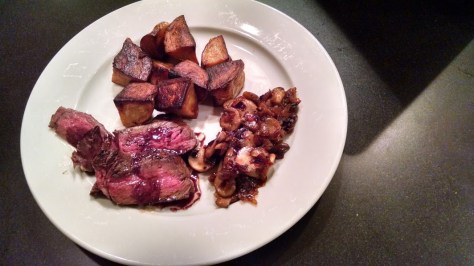
I added my obligatory browned potatoes plus sauteed  onions and mushrooms.  I thought about adding a kale medley (joke) but decided at the end to try a red wine reduction recommended by one of the sous vide websites I found.

Here is what the result looked like.

IMG_20160119_194814441_HDRIMG_20160119_194928024_HDR (1)IMG_20160119_195135141_HDR

And thanks once again to my kids for such a great gift.

Szechuan Chicken Sous Vide

For years, I have been preparing a dish I call “Szechuan Chicken”.  I adapted it from a recipe in a “Zone” cookbook.  It’s very simple.  Boneless, skinless chicken breasts are cut into bit-sized pieces and dredged in corn starch.  They are sautéed.  When they begin to brown, a couple of cloves of crushed garlic are added.  When the chicken is cooked through, several handfuls of green onions, cut into half inch pieces are added.  When those are starting to wilt, I add a sauce made up of about one half cup of soy sauce, one third cup of white wine vinegar, a Tbsp. of sesame oil, 2 tsp. of sugar, and 1-1/2 tsp. of cayenne pepper.  All of those ingredients can be adjusted to taste.  The sauce thickens as you stir and when it is fully thickened the dish can be served with steamed rice.  You can add crushed red pepper to taste.  The dish has nice heat that I really enjoy.  Also, it can be adapted readily for beef.  I use sirloin steak, cut into bite size pieces.

I thought it would be interesting to cook the chicken sous vide, then cut it up into serving pieces, dredge it in corn starch and proceed as above.  One downside to this method is that it takes an hour to cook skinless boneless chicken breasts sous vide, while it takes less than ten minutes to cook the dredged chicken pieces in a sauté pan.  But why not try it?

Before going on, I should acknowledge that there has been a lot of controversy recently, particularly on college campuses, regarding the preparation of foods associated with particular ethnicities.  It is considered a micro-aggression to offer an ethnic dish when (a) the dish is prepared by someone not a member of the same ethnicity as the food and (b) the recipe has been changed in any way from what a born member of that ethnic group would expect.

It’s surprising that college and university food services cannot produce genuine ethnic foods.  When I was a college student and was in the mood for authentic food, the first place I looked was the campus dining hall.  It’s tragic that standards have deteriorated to the point that you can’t count on university kitchens to produce authentic ethnic cuisine.

I would add that in this case, the kitchens of France are churning out micro-aggressions at a pace much more rapid than those of the United States.  French sauces in particular are often named for the geographical area or nationality that inspired them.  French cooks are notorious for taking the basic elements of another nation’s food and sublimating them to French methods.  Cases in point: Sauce Africaine, Sauce Italienne, Sauce Hollandaise, Sauce Allemande.  I could go on.  These sauces no longer have any real connection to the places for which they are named, although the place probably inspired the first effort that has been refined over decades if not centuries.  My point is that the people who are complaining about this particular species of micro-aggression should address themselves to the cooks of France before they complain about anyone else.  Not that they’re listening.

I am not from Szechuan, nor are any of my ancestors that I can account for, so I am in trouble already.  Actually, this recipe involves micro-aggressions within micro-aggressions.  I see that the soy sauce I use is Kikkoman, not a Szechuanese brand.  To make it worse, Kikkoman is produced in Wisconsin.  Where this will end, I don’t know.

A word about cooking times.  This is the third food I have prepared sous vide.  I cooked a steak to 129 degrees, which was supposed to be medium rare.  I thought it was rare.  Delicious, but rare.  I cooked salmon to 122 degrees, which was supposed to be medium.  I thought it was undercooked.  The recommendation for “juicy” chicken breast was 149 degrees for an hour.  I went to 155 degrees, fearing undercooked chicken.  It was not overcooked at that temperature, but I think it would have been better, possibly moister, at 149, which is the temperature I will use next time.

Here is what the chicken looked like straight out of the sous vide.  The second shot shows the interior of the chicken.  The food cooks beautifully but it looks plain and bland.

IMG_20160111_194623326

IMG_20160111_194809697_HDR

This is the chicken in the pan, after dredging with corn starch.  Garlic and green onions have been added.

IMG_20160111_195652810_HDR

Now the sauce goes in and thickens under heat.

IMG_20160111_195904270

Here is the finished dish.  Broccoli could accompany this if you feel that you must have a vegetable.


IMG_20160111_200128415

Downton Abbey, Season Six, Episode Two

Perhaps you will agree that this was not the most tensely dramatic episode of Downton that we have seen.  If so, indulge me in a little digression into the world of P.G. Wodehouse, which intersected the world of Downton in this episode, and not for the first time.

This is the second occasion on which P.G. Wodehouse has paid a call on Downton Abbey.  The first time was back in the early days, Season One or Two.  Mr. Barrow was merely Thomas back then, a footman trying to climb to the next rung of the ladder.  Lord Grantham was known to be extraordinarily fond of Isis the dog.  Thomas had the idea that he could win Lord Grantham’s favor by hiding Isis in an abandoned cottage on the Abbey’s grounds and then, after Lord Grantham had reached a state of high anxiety, finding her the next day.  Unfortunately for Thomas, someone else found the dog.  However, that is not the point of recounting the tale.

The stratagem is straight out of what Wodehouse called his “Blandings Castle Saga”.  Wodehouse is best known for his Wooster and Jeeves stories.  Bertie Wooster was a cloth-headed man about town.  Jeeves was his gentleman’s gentleman, a man of refined taste and profound learning.  His agile brain is put to use in every episode to facilitate Bertie’s escape from the impossible situations in which he lands himself.

However, Wodehouse wrote another series, which he referred to as the Blandings Castle Saga.  Blandings is a large establishment in Shropshire in the west of England, out near the Welsh border.  The castle is the ancestral home of Clarence Threepwood, the ninth Earl of Emsworth.  His sole passion in life is winning the annual Shropshire Agricultural Show Fat Pigs contest.  His prize pig, the Empress of Blandings, is a perennial contender.  Unfortunately for Lord Emsworth, his peace is disturbed in novel after novel by the younger members of his family, an assortment of nieces and nephews who insist on falling in love with completely unsuitable members of the opposite sex.

Four of the novels[1], at least, have remarkably similar plots.  In all of them, the unsuitable suitor comes to Blandings in disguise.  Wodehouse said that Blandings has impostors the way other houses have mice.  And in all of these stories, someone, often the star-crossed lovers themselves, steals Empress of Blandings in order to win points with Lord Emsworth when she is found.  There are always a half dozen other twists and turns of the plot, but in the end everything comes out all right.

How easy it is to take those same plot elements and, with just the slightest adjustment, produce a heart-rending melodrama instead of a side-splitting comedy.  The Fat Pigs contest is log-rolled into Season Six, Episode Two by having Mr. Finch visit the Abbey to talk to the “Agent”.  He and Mary go through a few minutes of “Who’s on first?”  “That’s what I said” until we finally come to the point that there is to be a “Fat Livestock” show on short notice and we need all hands, or in this case all trotters, on deck.  In order to enlist Empress of Downton, Mary needs to pay a visit to Mr. Drew, the Abbey’s pig man (not to mention part-time fireman, full-time dispenser of wisdom, and sometime foster parent).  Mary is the only person in Yorkshire apart from Mr. Molesley who doesn’t know that Marigold is Edith’s daughter, so she naturally takes Marigold along with George to visit the farm, unaware that she is putting a lighted match to the dry kindling of Margie Drew’s emotions.

Poor Margie’s heart is nearly broken in two when she sees Marigold at the farm.  When she sees the child again the next day at the Agricultural Show, she puts a Wodehouse-style plan into action.  But instead of stealing a pig to help bring young hearts together, Margie has stolen a child to heal her own broken heart.  The child was never in any danger, but who knows what might happen next time.  Mr. Drew comes to the same conclusion that Robert had arrived at earlier.  The Drew tenancy, which pre-dates the Battle of Waterloo, must come to an end.

P.G. Wodehouse made sure that all of his characters were taken care of.  Everyone enjoys a soft landing and a happy ending.  Mr. Fellowes cannot afford to be quite so gentle with his characters.  After all the fun of the agricultural show and the excitement of finding the missing child, whose location was never a mystery to the audience, Mr. and Mrs. Drew, two minor characters who have served Mr. Fellowes loyally, are crushed, while Robert, Cora, and Edith must recognize that they have not lived up to their own standards.  A most unhappy end to a difficult chapter in the life of the Abbey.

Incidentally, the butler at Blandings is named Beach.  He and Mr. Carson could give each other a run for their money when it comes to maintaining the proprieties in all circumstances.  I thought Mr. Carson might have edged Beach by a nose when, walking arm in arm with his fiancée, having a private conversation about their wedding plans, he addressed her as “Mrs. Hughes”.  Evidently the wanton informality of first names will not be indulged until they have been pronounced husband and wife.

But where will that pronouncement be made?  Mrs. Hughes wants the service out of the Abbey, neither upstairs nor downstairs, but Mr. Carson cannot break the gravitational pull of the Abbey, particularly after Mary’s insistence that the betrothed couple accept the family’s hospitality.  Mrs. Hughes was prepared to concede Mr. Carson the thirty years that begin on the day after the wedding, but as things stand at the moment, she will not win even that one day.

Anna and Bates get in their statutory round of regret, self-recrimination, and adoration.  At this point, no episode is complete without that little dance.  If they can manage to put their emotional pas de deux on hold for long enough to conceive, Mary’s doctor may have a surgical solution that will allow Anna to carry the next little Bates to term.  I hope for their sake that it comes to pass, although I expect that Anna will then spend her days crying that she’s not a good enough mother to the child.

A few aspects of Thomas’s situation piqued my interest.  First of all, why is Mr. Carson suddenly so hostile to Thomas?  Thomas has been an annoyance for years, but Mr. Carson has put up with him.  Thomas has not been openly offensive to anyone this season, at least not yet, but Mr. Carson seems to have it in for him.  Then when Thomas interviews for a job as an assistant butler – which we learn is a long notch down from an under-butler – the fellow who interviews him is almost openly hostile.

The interviewer is, I assume, the butler at the less-than-stately home where Thomas is applying.  His manner of dress and his accent place him a few rungs below Mr. Carson on the servants’ social scale.  I was curious that he had Thomas’s sexual orientation figured so quickly.  He did not appear to be especially tolerant in that regard, but could there be enough gay servants wandering around rural Yorkshire to bring the question to the front of the officious butler’s mind?  Added to that, the job itself seems unappealing, including as it does the role of footman, valet, and part-time chauffer.  I don’t see Thomas choosing to settle in there, even if he is offered the job.

The theme of the advancement of women is in full bloom.  It’s a subject of long standing at the Abbey.  We remember Gwen from the very first season, the lowly housemaid who became a secretary, and she is not the only example.  Here in Season Six, Mary is now fully in charge as Downton’s agent and Edith is slowly but steadily taking her publishing business in hand.

Isobel is doing a masterful job of winning the argument to modernize the medical services available to the district.  It appears that she has encircled Violet and Dr. Clarkson and left them to stew over their upcoming defeat.  Robert cannot oppose his mother and so remains neutral.  Cora is a stout ally and so is Lord Merton.  Of course, Lord Merton would have sided with Isobel if she had proposed that they hop into a couple barrels and roll their way to London.

But the whole business with the hospital was done in such an undramatic fashion.  In the old days, we would have had an outbreak of scarlet fever and Dr. Clarkson would have stood before a window, his sleeves rolled up to his elbows as yet another body was rolled past him toward the mortuary, and confessed that he was overwhelmed and needed help.  In this lackluster season, will he and Violet do nothing more than sulk until Isobel’s victory is complete?  Perhaps the old guard still have a fight left in them.  We shall see.

Meanwhile, Daisy is becoming more deeply radicalized with every episode.  She wants Cora’s help to restore Mr. Mason’s lease, but she also holds Cora responsible for Mr. Mason’s dilemma.  Of course, she doesn’t hold Cora personally responsible, but Daisy sees Cora as part of the system that has taken away Mr. Mason’s farm.  This kind of proto-Marxist ideology must have been on the rise in 1925.  The next year, Britain experienced the famous “General Strike”.  It was unsuccessful, but was a clear sign that the workers were not satisfied with their lot in life.  Whether our story will reach into the next calendar year remains unknown (to me).

I was gratified to see that a few predictions I have offered – always reluctantly after the shocks of 2012 – are on the verge of coming true.  Cora has indicated that she has an idea in mind for Mr. Mason.  I would wager a small sum that she is going to arrange for him to take over the Drews’ farm, from where he will be able to assist Mary in keeping the pigs and advising on the agricultural affairs of the Abbey.  Also, looking at the previews of the coming week’s episode, I see that the fellow who showed an interest in Edith last season – the “agent” at the estate next door to the Sinderbeys – was talking to Edith.  Finally, the fellow who was shooting pheasants while Mary insulted him will also be making an appearance.  I don’t think it took any great insight to make any of these predictions, but having tasted the bitter dregs when I have been wrong, I look for any chance for vindication.

One last point.  This episode and the previous one opened in the usual way with a close-up shot of Isis’s tush.  The dog died last year.  Shouldn’t we have an updated opening?  The end of the show is in sight, so it’s understandable that the producers would hesitate before investing in a new opening segment, but surely budgets are not that tight.  If each of the upper class ladies gave up one extra gown, that would undoubtedly cover the cost and it would help me to avoid asking each time why we are seeing the hindquarters of a dog that died a year ago.

[1] Summer Lightning, Heavy Weather, Pigs Have Wings, and Full Moon.  The first two form a sequel and are comic novels of the very first order.  Possibly there is a barely noticeable recession of quality in the third novel.  The fourth, Full Moon, is a work of comic genius.  There are other Blandings novels and a collection of short stories as well.